This is my first post to this forum (and still own an early PSAudio DAC, the Digital Link III, I think it’s called!)
I’m building a new home that will have a (for me) large listening room and library. Rectangular and approx. 17W by 28L by 12H at the peek of a vaulted ceiling. This is very close to the so-called “golden ratio" (I’ve read and watched Paul on this topic as well as googled around generally).
The walls will be 9 ft tall. The two long 28’ walls will be entirely lined with books–approx. sixteen bookshelves full. The “back end” of the room will be for study and have a library table and chairs around it. The “front end” will be for listening. Since this is a dual purpose room, I will not start with the rule of thirds. Instead I plan to locate the listening position roughly half way into the room, making the listening triangle about 7 feet with half the room behind me (basically my office space). The long exterior wall will have transom windows running above the long row of bookshelves. There will have to be a picture window on the back window for good light during working hours.
I have an excellent 20 watt tube amp and efficient open baffle speakers. I will likely stick with such a setup. My question is this:
Are there things I should be telling my contractor that do not cost and arm and a leg (and don’t scuttle the need for this to be a library) that would noticeably improve my prospects of excellent room acoustics. I read, e.g., that using special wall insulation or putting up double dry wall can help. Yet with so many built-in bookcases and books lining the entire room, I should think that extra effort there would yield minimal effect. The books should serve as good diffusers, esp. at first reflection points. In my current space I have about a dozen GIK 4 by 8 bass traps, some of which I could play with on the from wall.
The floor will be concrete slab on grade, which I understand is a good thing. For cost reasons, I plan to put a low pile carpet in the room instead of wood. But back to my question:
Does anyone have advice on things I might ask the contractor to do in the building process that would make improvement without going the full route of turning the library into a sound studio?
Acoustic treatment leave for the experts. Are you going with 1/3 in for speakers 2/3 seating? That’s a good start to tell the designer.
GIK has in house designers so does Vicoustic. You need a dealer for Vicoustic. But not GIK.
Independents like Ron suggested are always good as you will get the personal touch with them, probably spend a bit more.
The one thing I do know from reading is you will want to raise the floor. Yeah I know it costs more but it kills the floor reflections a bit too.
2x4 pressure treated strung front to back 2 ft apart to fit the ridged insulation in-between. Then 3/4 plywood on top. Carpet on that. its makes a big difference. You can have the builder do that if you are not at that stage yet.
Have you given any thought to your electrical system? A dedicated sub panel for your stereo equipment separate from lights, heating/ac, and other common electrical loads is worth investigating. Consider also attending to your grounding system to drop resistance to earth ground as low as possible.
I also recommend you purchase “Get Better Sound” by Jim Smith. Mr. Smith’s book is more about getting the most out of your room (proper speaker positioning, acoustic considerations, listening position, etc.), but I think it would be an excellent (and very fairly priced) reference that would be useful as you design and build your room.
Really very cheap now and expensive later. Run at least two 20 amp dedicated lines to where you plan to put your electronics and two more to your second choice location. Put two double gang boxes at each location where each line serves a separate outlet in each box. Use hospital grade outlets, as they are built to clamp tighter on the plugs. PS Audio outlets are nicely built and competitively priced in a five pack.
Hi Brent. I hate being so blasted busy - I almost totally missed this post.
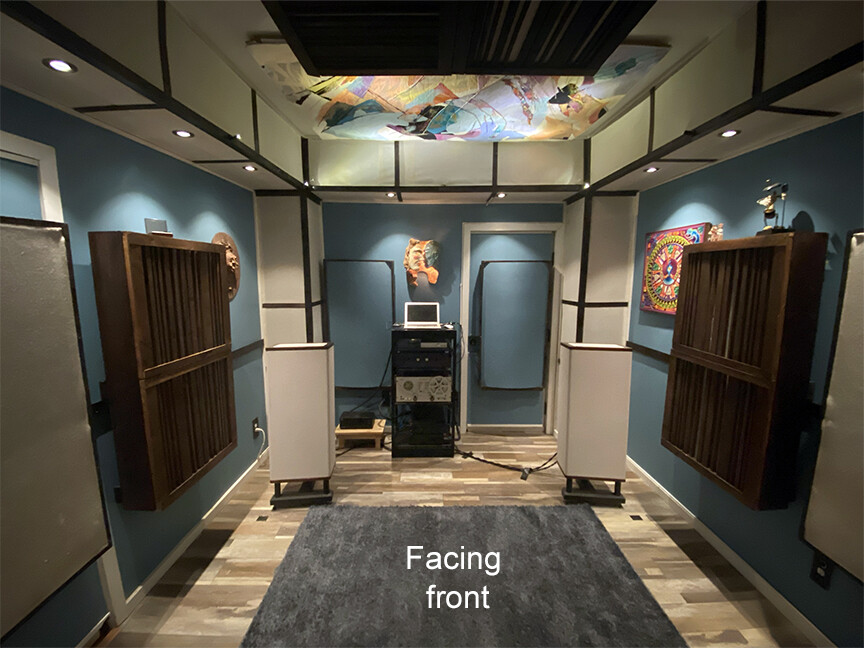
Two years ago, I built out an unfinished basement and decided to create a dedicated listening room. I didn’t have a huge space to work with, but after doing a LOT of reading and asking questions, it turns out to have been the best thing by far for improving my listening experience. And I am still pretty new to the high-end audio hobby and do not have a huge budget to work with.
You asked about working with a contractor, and that is one area where I really lucked out. I was having to do the basement very reasonably and found a 2-man group that got very interested in the room, to the point they were suggesting ideas to me that ended up improving things. I had read stories where contractors completely refused to do things, not having enough time, etc. Not once did my guys (at least not in front of me) even roll their eyes at my direction to put “Green Glue” between layers of sheetrock!
Details of my room are captured in this thread on the forum. If you have questions, please ask. I was really fortunate that another member of this forum offered me a lot of help FOR FREE, so I’m willing to pay it forward. Just bear in mind that I am NOT a professional acoustician or sound engineer. But I did really enjoy doing the project and have thoroughly benefitted from what I hear in there.
And it doesn’t just look terrific! Seriously, my real inspiration for doing it was something I read about how acousticians are paid big bucks to design the spaces - studios, concert halls, even cathedrals - to maximize the sound quality of the original music being created, then we play it back in an environment designed for something else, expecting our speakers to just magically do all the work. It took me back to my brief career as a recording engineer and remembering the guy who designed the studio I worked in. I also spoke to an old friend who is now doing recording in a home studio and the details of what I did for my listening room are identical to what went into his studio - building a room within a room, the “golden ratio,” internal treatments, dedicated AC power, etc.
Indeed they are Vandies. 2ci. Bought them used from a guy who took amazing care of them. I’ve had to replace the woofer on each over the past two years, but I heard no reduction in quality. I’m considering upgrading to Aspen FR5s, but I’m really nervous about the possibility of losing what these things do for acoustic instruments, including voice, which after reading many reviews is why I got them in the first place. My previous speakers were Dahlquist DQ-10s which I liked, but they just seem to have been made for rock music, which is about 10 percent of what I listen to.
And that photo is a bit older - I’ve recently added an REL subwoofer T/7x and after trying it in every location in the room, settled on plunking it dead center between the Vandies. Not only my ears, but my room-correction mic and software like it best there too. Moving to DSP correcting was probably the second most noticeable change I’ve experienced. Just knowing that my system is being tuned using the same philosophy as used by engineers designing mixing rooms helps me believe that what I’m hearing is what I’m SUPPOSED to be hearing. The bass on the Vandersteens is great, don’t get me wrong, but addressing problems a room can cause - especially a smaller room - enables me to feel so much more accurately what’s going on in that first octave.