I waved the white flag and just decided to run all my digital sources through a Schiit Bifrost Multibit (1st edition). There’s something about the sound of that DAC that is just infinitely pleasing to my ears. Who needs DSD anyway?
Oh. And with a cheap Chromecast audio streamer. I’m alllllll about value.
I know I’m late to the party on this thread but reading it was like a walk through the last 2 years of my personal journey for optimized and simplified streaming
Compared to most I consider myself a rather lazy audiophile and know I’m leaving something on the table because I do not have ideal speaker placement, room treatment, consistency in vibration management, etc
It’s an 80/20 thing for me, I’ll settle for 80% of the SQ for 20% of the time investment. I cannot recall the specific theory, but in my over simplified mind it would take me 400% increased investment in time to achieve the other 20% of the SQ
These same 80/20 guidelines are the biggest reason for my personal preference in streaming vs physical media
I also think the economics of Roon, Qobuz and Tidal streaming subscriptions to be advantageous to the cost of CDs and vinyl
That said I’m a recent streaming convert. For the first 6 months that I owned my DSD, I didn’t use the network bridge
My streaming discovery started with a simple iFi Audio ZEN Blue, streaming YouTube from my phone over wifi via Bluetooth and playback through a secondary system in my office. Simple, low cost and convenient
Tried to take that mobile using wireless headphones while riding my bike
It was functional but the SQ was lousy and I couldn’t find a pair of wireless headphones or earbuds to remedy the issue
That led me to an Audioquest DragonFly Cobalt with a free 60 day subscription to Tidal and Qobuz and I went back to a wired set of Cardas earbuds. I did have to add an after market USB driver to my Andriod phone to get bit perfect playback
A whole new world that I was delighted with and was able to playback via USB aux in the car. People thought I put a new system in my car and the only thing that had changed was streaming hi-res through the DragonFly
Next step was how to stream to the DSD. Once again late to the party, a bit of a slow learner and don’t forget lazy…Roon was the direction I took, it manages all the backend streaming libraries from a single pane of glass and the integration to the DSD network bridge was so simple I was kicking myself for not having done it sooner. Not to mention the SQ was vastly superior to what I was getting from my basic Audiolab CD transport
I eventually evolved to where my listening was 80% streaming, 15% vinyl and 5% CDs
I did enough digging to learn the general guideline for hierarchy of the different interfaces on the DSD was spdif, USB and I2S. I also thrashed around on audio grade ethernet cables and switches which seemed sort of hit and miss
I ran across Small Green Computer, and Andrew took a slightly different approach coming out of the network switch via sfp and fiber instead of cat6, and essentially building an optical network.
The optical network completely eliminates noise by using glass optical fiber to transmit network data instead of copper wire. Any Ethernet cable made of metal, no matter how well made, can still pick up electrical noise radiated through the air. Optical fiber can not pick up any noise because it’s made of glass not metal
The other end of the fiber goes to a device with USB out that can go into the USB input of the DSD, or you can up the ante again and add another device that takes the USB to HDMI and into the I2S input on the DSD, which is the route I’ve gone
My system has truly NEVER sounded better
Once I got Roon configured correctly to easily swap between the end points the blind A/B testing between the PS Audio Bridge II Network Card and the Small Green Computer System Optique was easily discernible to even an untrained listener
The overall sound improvement is significant with numerous raising the hair on my arm moments of the same music I’ve listened to 100s of times over 40 years
When the veils are lifted, a hidden tambourine in the hands of artistic percussionist can truly convey emotion
I must admit I was a bit of a sceptic that multiple devices with multiple cable conversions would sound better than a native network card running at bus speeds
In the end there’s some special sauce going from cat6 to fiber to USB to I2S
A thing of technological beauty that I’m pleased with from ease of setup, price performance and most of all SQ
I love this hobby and enjoy the PS Audio family
As indicative of the responses to this thread our routes and directions can be very different but our goals and destinations are often the same
Enjoy the journey my friends
Welcome.
Welcome, @Steve_Wharton !
Steve, I really enjoyed reading your missive - to be honest I was expecting it to end with you saying that you’d found God!
Dano sometimes it is a near religious experience
The closest I get to God is when she sticks her head in to remind me that it’s late and tell me to turn it down…hehehe
Way to go!
I’d hang in there. See - DSD 512. But how is it created? And why? | NativeDSD Help
I just rebuilt my streamer PC to “W11” AMD R5 5600G capability as the old i7 3770 system was EOL with W10. What I also did, was set the J.River to stream to the DAC native DSD512. And WOW is that filter process better sounding than the PCM side (my DAC does either). True, zero more data but the data is simply better sounding. The converted AIFF, FLAC or WAV are all way better sounding as native DSD512.
I 100% agree digital is a mess of stuff you sort out with all sorts of hidden and unintelligible settings (look inside J.River sometime!). It took awhile to sort it out and I thought I was setting up just DSD to be DSD512 from DSD64 but it turns out J.River stream DSD512 via USB to the DAC on ALL initial file formats. The faster CPU may be of benefit, not sure, as the PC has to do the streaming grunt work.
I have no issue at all once I’m set up with USB cable to the DAC from the PC. GETTING the settings is not easy. This is more stable and higher BW than what Ethernet I have (wi-fi 5 best case).
But I hear you loud and clear on the complexity of a LAN, PC, software and a DAC with all it’s settings. Any of which that are wrong and you get zip or no way what you want to get out of your stuff.
Best,
Galen Gareis
Galen,
I may have spoken too soon. Today my streamer refused to turn on and once I did get it to turn on (unplugging it, relocating, then restoring), it rebooted itself halfway through an album. I’m afraid the refurbishment process didn’t catch a flaw.
I’m back to throwing my hands in the air and just sticking to redbook through a Chromecast Audio.
Grumble, grumble, grumble.
I’ll bet those DSD files sound sour anyway.
Make your own! This way you know what it all is.
- Use MINIMSERVER on the PC (free)
- Use bubble UPnP contro, on your Android tablet or phone (five bucks).
Get fancy and you can use J.River for $55.00 lifetime license.
If you can build a standard PC this is the way to go. Mine is as follows (just built it);
Cooler Master ELITE130 ITX type case.
Gigabyte B550 Aorus mini itx MB.
AMD R5 5600G with graphics. Use the stock AMD heat sink supplied…trim the plastic bottom edge for clearance above the I/O ports.
16 GB G.Skill 3200 AEGIS memory.
Seasonic fanless power supply, 400 watt model (now 480).
Samsung 980 DRAMless NVMe SSD. You don’t need the expensive DRAM for a boot drive just make it big and let TRIM load leveling take care of you. DRAM is for sustained LARGE file transfers. It works, but only when you actually use it otherwise it doubles the price of the drive!
Seagate iron Wolf NAS 6 TB HDD.
W10
JRiver on PC (a luxury but a nice one).
MINIMSERVER on PC.
Bubble UPnP control.
This works very reliable and better yet, you know what’s what as you did it! True, the initial software settings are a pain, still. But once you do them a low power silent mode PC works well. Mine streams native DSD512 with zero issue on USB or hours and hours from J.River.
People make claims about a streamer’s “sound” but I’m not hearing that. I hear the better filters that streaming native DSD512 affords ANY DAC and THAT is what you are hearing, the filters better sound. You aren’t hearing the DSD512, or above DSD64, stream directly as the data BW is the same so the way DSD works, the filters can be more accurate, some tech stuff there to explain why that is by the pro’s but it’s true. DSD is nice tech.
True, if you can’t get DSD above native DSD64 (about what SACD originally was) on your own with a PC, a pre-built streamer is better, can’t argue with that. But, it still needs to be firmware robust (use a custom form of LINIX) and easy to understand the settings pro and con.
Digital will have to get way easier for most of use to reach full higher-end adoption no doubt.
Best,
Galen Gareis
My SGCD is very very picky on USB signals.
I’ve tried multiple Raspberry Pis running Ropieee as well as dragging my Roon NUC (running ROCK) next to the stereo to connect it via USB and Roon and the SGCD just skips through the queue playing nothing. It’s frustrating. But my iPhone/iPad seem to play okay via USB.
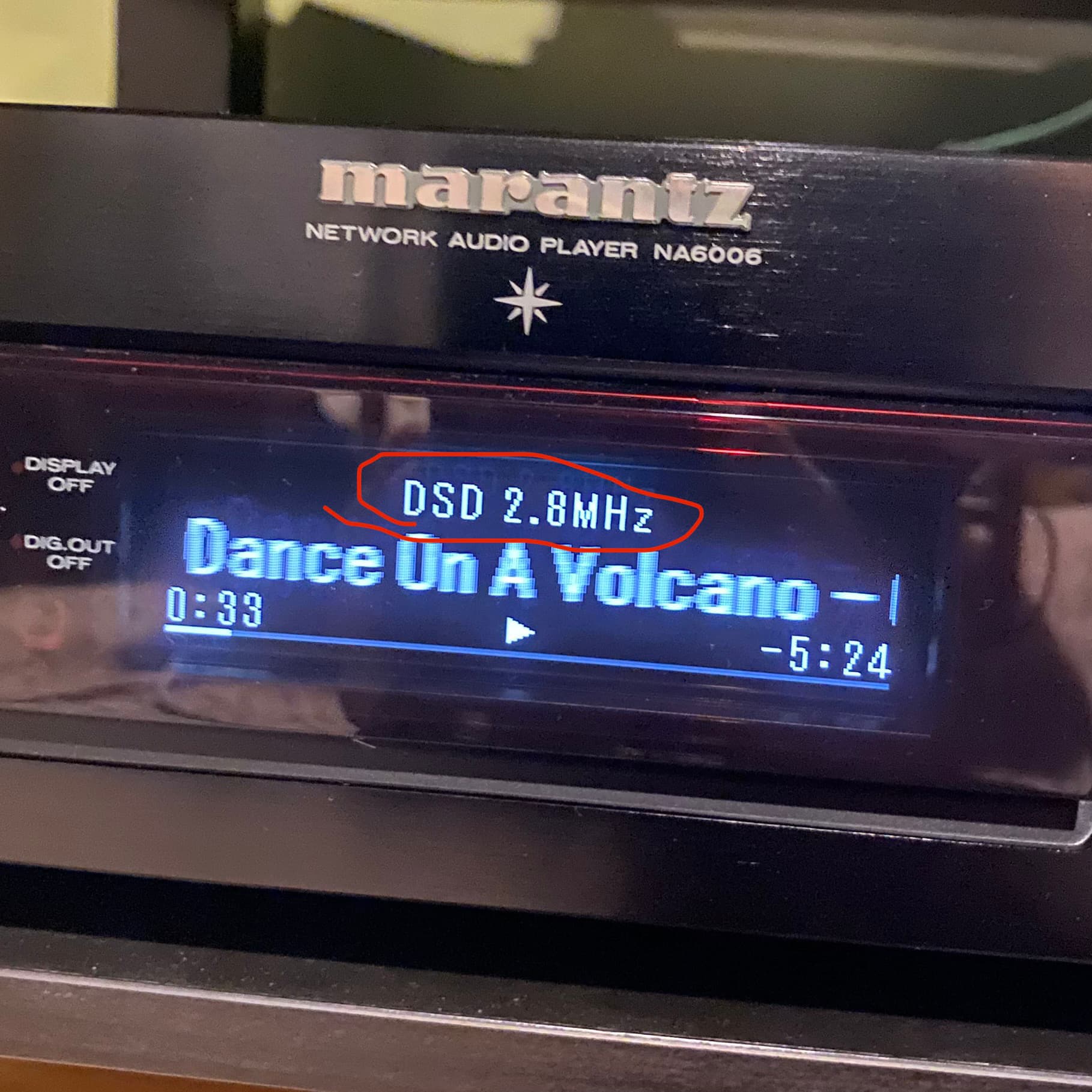
I suppose I’ll probably send the Marantz back to Music Direct. If it doesn’t want to play reliably, I give up.
It’s fine. If I’m in the mood to really mess with my DSD files I can always hook up my iPad directly because the SGCD seems to like it better than the other choices. It would probably be best to just upgrade my iPad and leave my current one connected all the time.
Mike whatever happened with the Zen Stream?
Same deal as the Pi. Roon would queue up music and you’d hit play and it would run through the entire queue in about five seconds and no sound. I don’t know if the problem is the streamer, Roon, or the SGCD. But since the Zen was returnable, back it went.
The Marantz worked more or less. Roon played through AirPlay 2 which isn’t ideal, but something I could live with. But today it started acting just defective, so I expect it’s a real hardware problem. It was a refurb, so, since it was a problem that only pops up if you’re playing for a while, I suspect that’s a flaw the refurb didn’t catch.
I’m just chasing edge cases here so I think I’m just gonna hang it up and live with the Chromecast/Sonos way. It’s not like I have an enormous library of DSD/HiRes stuff. Just a few things and Roon can downsample it anyway. I was just chasing native stuff and frankly, that’s not something I need to screw around with or lose sleep over. Time to be a grownup.
Mike
I don’t own a Zen as I don’t need one but as I’m curious about it I’ve followed the 60+ page thread on Headfi that includes reps from iFi. Seems that some of the earlier “bugs” have been worked out including the release of their own software and changing power supplies so if you haven’t you might want to read through that thread and see if you see something that would let you try it again. Most of the users are using it with Roon on the dedicated Roon setting so the issue may be with the USB port in the SGCD. Also some of the power users might guide you in getting it to work.
Thanks for sharing your experience, I like reading it.
But why are you a 100 % streaming converted?
I play ripped files / streaming 80 % of the time and indeed don’t care about the last 20 % SQ. Simple hook up CAT6 Ethernet to my integrated streaming amplifiers. No high res files, no USB, no hassle. Very good streamers and amplifiers and my old CD players and turntable.
Nowadays digital radio and streaming is the second best way to explore new music.
The best way is visiting concerts. There, I always buy the artists CDs if available. It are not world famous artists I visit. Local high quality music. It supports new talents and is yet much more affordable. The SPLs are of moderate level such that I do not need to fear for damage to my ears.
Still on the 3rd place is visiting the record store.
When I was young listening to music with friends used to be no.1 but everybody has moved on and Covid 19 has not been supporting getting together either or visiting concerts for that matter. Hugh, the good old times.
Anyway, the other 20 % of my listening time I play physical media, not predominantly because it sounds better, which it does, but because of many other reasons:
- artists are paid way better if you buy physical media
- much music I listen to is not available by streaming
- I love mechatronics and therefore just enjoy operating my turntable and CD player
- physical artwork is so beautiful
- I like grinding through the albums (with beautiful cover art) in the record store
- independence from the internet, if it is down, I still can play music
- I can cancel streaming contracts whenever I like, without being restrained by lack of options
Spinning discs or even tape reels has always been a wonderful part of the music listening experience and will be for as long as possible.
I haven’t read most entries in this thread but if you want dead simple streaming using a source like your phone over Bluetooth I highly recommend the Audioengine B1. It’s $200 and includes a good DAC or you can connect via Toslink to your DAC. I have two of these and they never hiccup. Stream hi-res from my Phone via Qobuz and now Amazon HD Music and the sound is great.
I never spent so much time dicking with technology since digital in general. I am going back to booking live bands in my home. Yea, a bit expensive, but the imaging is amazing, and horns sound like real horns.
Peace
Bruce in Philly