Wow, that sounds like a really good strategy. Yeah, I’ve had that free DB Meter app for several years. But does that consider nodes and standing waves and all that?
One thing I keep forgetting to add: I have a loudspeaker test system from 2xHD that for bass testing uses an Octabass - an instrument that is like an octave below a standard acoustic bass. It goes down to 28 Hz. But the interesting thing about the test is the harmonics. Each of the octabass tracks indicates which harmonics are coming along with the fundamental tone. So it helps set the sub so it respects and doesn’t overwhelm those higher frequencies.
Yes that’s the best part of the subwoofer crawl. It finds the best place super easy. Used the room and where u sit as base. Amazing change when I did that
1 Like
I have an anthem AVM60 with ARC (Anthem Room Correction) that handles the bass crossover between the speakers and the subs. The crossover starts crossing at 50Hz. The digital equalization stops at 500Hz. The green line after that point is the natural response of my speakers in the room. The red line to the left of 500 Hz is the natural response of the speaker in the room. Lots of bass reinforcement happening there which the two subs plus eq smooths out. The black line is what the EQ calculations are trying to achieve.
The calculated EQ curve is in green:


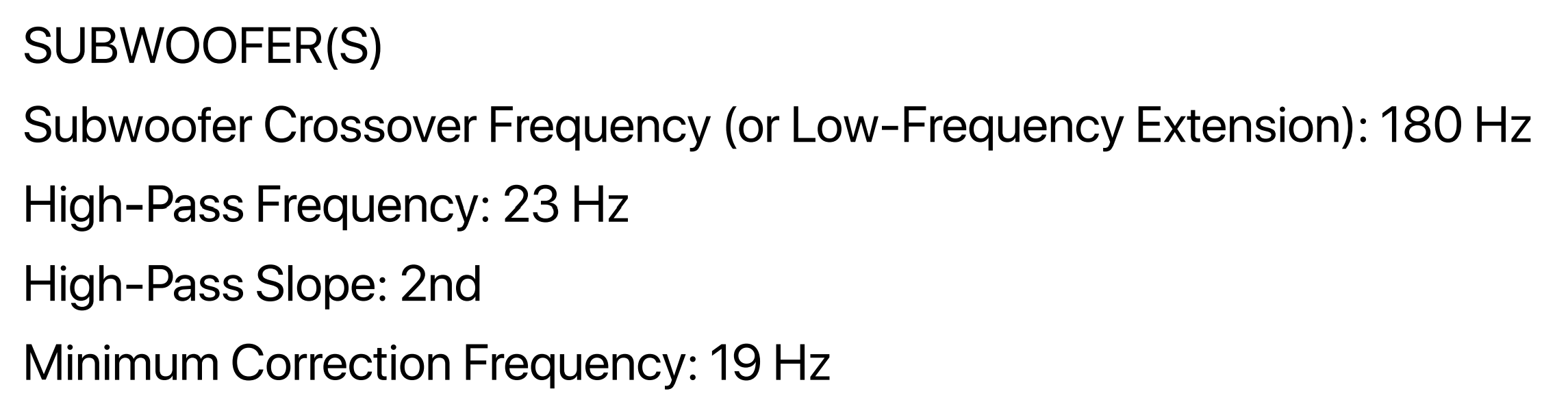
One more thing,
His voice never only comes through the subs. If you listen closely there are tons of overtones in his voice that you would never want routed to the subs.
I’m a fan of ‘nearfield’ positioning for the subs. I tried it not expecting very much but it ended up being the best-sounding location for my (untreated) room.  I was amazed at how well they integrated with the mains. You couldn’t tell they were right beside you!

Oh, in case you’re wondering, the subs having opposing front and rear drivers (bipoles?)
4 Likes
First time I have ever seen the speakers set up behind a TV (or are they on the same plane?).
Interesting…
Yes, you got me Scott  My accommodation at the time was rental so I wasn’t too fussed with set up. Perhaps we could use the photo as what not to do.
  The TV’s in front of the baffle plane of the mains. It doubled as my PC screen so couldn’t be too far from the seat! Not an ideal set up but it didn’t sound too bad. That’s the last set up I had back in 2022 before I packed it all away for another move. Sadly, it’s still packed away due to the limitations of my current accommodation. I’m looking forward to setting it all up again, particularly with everything I’ve learned about set up since 2022!
2 Likes
Question for ya: so you say the ARC “handles bass crossover between the speakers and the subs” - does that mean that the ARC system has separate physical control of the speakers and the subs? If so, how does it do that? I have a similar question asked today on the Paul’s Post comments - someone was talking about active crossovers and I asked: “For the REL sub to get its signal, there are two choices - 1) from outputs in the pre-amp, or 2) from the speaker connections of the amp. REL highly encourages going the latter route because the sub will be getting identical info as the main speakers. The crossovers I’ve seen are in between the pre-amp and the amp, which if I’m using scenario 2 (recommended), the active crossover would be affecting both the main speakers and the sub, right? So I’m telling it to roll off below 40 Hz in the mains, wouldn’t it also be rolling off below 40 Hz in the sub? Or am I missing something as usual?”
His reply: I too have tried both inputs (RCA and speaker level) to my subwoofers and they sounded the same because subwoofers play low frequencies which aren’t as noticeable as the mids when I change in/out other components, however I was at the time using the subwoofer’s builtin crossover, not a separate 2-way or 3-way active analog crossover. [Jon’s comment: one of the things REL says about connecting the sub to the speaker leads has to do with TIMING - that there can be subtle differences in timing between what comes out of the pre vs. the amp]
You’re crossing over at 40 Hz to the subs which is so low that you’re not going to hear any difference.
Side note: Crossing over below 80 Hz causes IMD distortion so your vocalists are not going to be as clear. I’ve noticed that Elvis sings at >130 Hz so I’ve set my crossover to that. [Jon’s note: I think this is the only audiophile I’ve ever met who is an Elvis fan - and no, it’s not Costello - and yes, I told him I thought it was weird]
If the subwoofer already has a builtin amp, then that external amplifier can be used to give other speakers more headroom (or not use it and save electricity).
Yes, an active crossover would be affecting both the main speakers and the sub.
NOTE: the quicker the roll off slope, the better cleaner the sound.
Back to me: does this stir any thoughts? I’m not sure my ears would ever hear things like the difference between sub from the pre-amp vs. the amp, but I do wonder about whether I should be trying to “relieve” my mains of even DOING below 50 Hz.
Yes. This is one of the reasons the connection from the amp is the way to go.
My ears definitely hear a difference. Others on this forum encouraged me to get my Infinity crossover box out of the signal path. They were right.
The REL places minimal load on the amp, minimal enough to be called no load on the amp.
1 Like
For two channel using high level is the way to go especially if you have full range speakers. I have done it all ways. Using AVR, then passthrough to two channel no sub. then I added a JL CR-1, and now using high level inputs to sub via the amp connection as Paul says above.
By far the best sounding is high level. To the point where I separated my 2 ch from HT and have dedicated subs each sized for that application (dual GHP25’s for HT) and Dual F12SE for two channel (both Rythmik).
The blending you get for music over high level is so smooth. Using a cross over with full range speakers just limits the dynamics and overall feel of the music.
Hi Brian, so last night I tried the idea of putting the sub at my listening position and generating tones to see where I get the most dBs in the room to decide the “spot” for the sub. It was fascinating. At 20 Hz, it was just “feel,” but both the Vanderstein mains and the REL sub were audible. I suspect my ears just don’t go that low really. When using a 31.5 Hz tone, which was more distinct, it was even all around the room (about 70 dB), even right above the sub (in the listening spot). Then I went to 40 Hz and things got interesting. It seems to generate a much more “sympathetic” if not standing wave right at the listening position and on the plane with the main speakers. In other words, if I walked from the front wall to the back, it starts moderate, then loud at 1/3 back, then moderate until suddenly loud at seating position (2/3 back), then moderate to the back wall. But even with the added sympathetic effect, the meter was still around 70 dB). So since it was loudest at the plane of the main speakers, I moved the sub smack in the middle betwen the mains and started over on REL’s set-up procedure. The settings corresponded pretty close to their “typical case scenarios” where I did crossover around 60 Hz and level about 2/5 of the way up. As I tested actual music, I would start with the sub turned totally down, then bring it up to the 2/5 position. At no point did I feel the sub was overwhelming the mains or too “fat” as REL called it. I just decided I was going to have to go with “preference” and ask myself, “does it sound better, wider, more spacious with the sub on?” The selections I chose were from this thread and I’ll report them separately, but I will say that a) there was nothing “absent” in the low-bass information without the sub, but with the sub at that setting, things were definitely richer and I can’t imagine the recordists wouldn’t have wanted the low bass about there. So long story boring: I’m not sure your technique worked correctly for me, but I do feel it was an improvement in the sound.
1 Like
Yeah, I figured that when I previewed the recording on my Apple Display Monitor which does have pretty decent speakers. But then when I actually played the recording on my system - WOW, I had no idea that lower bass was even in there, probably at least an octave below his lowest note.
So I just reported to @brian.fitterman how I tried his trick of putting the sub in my listening position and hunted for the loudest spot to determine where to put the sub, then went back through REL’s suggestions on how best to set it up. Including your recommendations, here are my findings:
- Felix Laband from 2005, “Sleeping Household” and “Minka”: now that’s some interesting sounds, and sounds they are, very 3-dimensional and inside my head. For this, I didn’t really get much more as far as soundstage or depth, but I certainly got more out of it with the addition of the lower bass.
- Stevie Ray Vaughn & Double Trouble, “Tin Pan Alley”: now here’s where I really started to hear a soundstage difference by the better-rendered lower bass, where the bass just filled out, allowing the rest of the ensemble to “breathe” better. Man, that guy was good - hard to focus on the bass with SRV playing.
- The Eagles, Hell Freezes Over, “Hotel California” - Same as Stevie above, but with more colorful instrumentation, it really “swung” better (using a jazz term). I found I could better distinguish the “notes” of the bass, which is one of the reasons I prefer acoustic bass over electric, but here I could tell more of what was going on by having the fundamental notes in the sub. That bridge area at 4:44 was phenomenal - with or without a sub
- Charles Mingus - Ah Um - “Jelly Roll.” OK, I’m more about jazz, and I know this recording very well. But I’ve never heard it quite like this. And what I mean is that Mingus’ bass is never over-emphasized, but I could really hear what he was doing, the role of the bass in the ensemble. This was probably my favorite of the list of suggestions, but not because of the excitement of the sub, but in being able to hear bass with appropriate depth. Was this what the producers in 1959 had in mind? I’d like to think so, but could their monitoring speakers even reproduce what was in the recording? Not so sure.
More to come.
4 Likes
Before replying to this, I read the rest of the posts in the thread.
I’m glad that you got the placement nailed down.
My receiver is a home theater receiver. Audiophiles may dislike this, but all the analog inputs to the receiver are digitized by the receiver and run through its digital signal processor, which adjusts the audio signals to compensate for the room acoustics that it measured during the configuration process.
The digital signal processor directs the signals to the appropriate speakers based on the input signal and the number of speakers I have. I have a 5.2 setup (5 speakers - Left, Center, Right, Surround Left, and Surround Right, and 2 subwoofers). I can do things like have the stereo signal sent to all five speakers, surrounding me in sound, but it doesn’t sound very natural. So, when playing two channels, I only use stereo playback. In this mode, the signal processor in the preamp analyzes the signal from the left and right RCA cables, routing the sound to the left & right speakers and the subwoofer according to the crossover values I shared. The subwoofers are connected to the line-level subwoofer output, which is used by the LFE track in movies, and is also where the bass is sent according to the crossover settings.
Regarding your question about hooking up your sub, I recommend following the manufacturer’s recommendations. They know how their product is built and would be the best source of advice for how to set it up. I believe they recommend you connect the sub using the speaker-level connection. If you do this and you only have one subwoofer, then the subwoofer will only receive the lower octave audio from the channel (right or left) to which it is connected. This is one of the reasons why people recommend two subwoofers. When connecting speaker-level connections to the sub, the “left” subwoofer gets the low octaves from the left signal, and the right subwoofer gets the low octaves from the right signal. If you don’t have two subs and your preamp has a subwoofer out, you should definitely try connecting the subwoofer that way, as the preamp may average the lower octaves from both speakers into the sub out, giving the subwoofer a blend of both channels instead of only one channel or another, depending on which speaker level connection the sub is hooked up to.
Another thing you should try once your sub is in the final position is to adjust the phase. A quick AI search reveals that Rel subs only have a 0 or 180-degree toggle switch. Since I don’t 100% trust AI answers, if Rel only has a toggle switch, try each option to see which one sounds better. If you have a continuous adjustment between 0 and 180 degrees (a knob), then you sit in the listening position and have a friend or partner turn the phase knob on the sub as you play back the bass test tracks used for the subwoofer crawl. Have your friend or partner stop turning the knob when you hear the bass that you desire.
Thanks for sharing those tracks. I will queue them up on my system this evening and check them out while waiting for your report on how it went.
The last thing I will say is that once you have it set up the way you like, it is set up correctly, and it doesn’t matter if it isn’t set up the way Rel recommends or, frankly, anyone else suggests (except me, of course  ).
).
Good luck!
3 Likes
One more thing. The crossover option you choose might need to be different than the one I chose. That setting is very dependent on the low-frequency extension of your left and right speakers. My speakers (Focal Sopra No. 2) only extend down to 34hz. SVS, the manufacturer of my subs recommends that the crossover be set to 50Hz for these speakers. If your speakers go down lower than mine, consider lowering the crossover setting on your subwoofer to 40 or even 30 Hz. If your speaker doesn’t go as low as mine, then you may find that raising the crossover frequency to 60 Hz or more would be better. But, I don’t recommend ever setting a crossover higher than 80Hz. Above that level, your ear is better able to tell where the bass sound is coming from, and you don’t want that.
REL recommends, for one sub, to connect the red wire to the positive output of the right channel and the yellow wire to the positive output of the left channel. The sub then gets signals from both left and right amp outputs.
3 Likes
Thanks. I was not aware of that. They thought of everything.
1 Like
If you are looking for three dimensions like these two tracks, you should also check out Madonna’s “Vogue” on The Immaculate Collection album.
1 Like
I am glad somebody else mentioned Vogue. It has amazing 3D sound. I only play it when nobody is listening ‘cause, you know it’s not “old guy” music.
2 Likes
LOL! But Tom, Madonna is quickly getting to be “old guy” music. It was 42 years ago that I worked in a record store, managing the “old guy” classical and jazz sections, enduring the playing of “Borderline” over and over and over…
1 Like