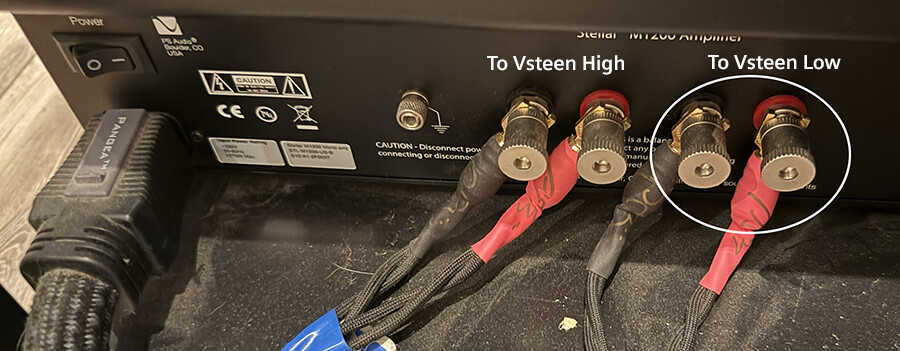
I’ve heard that when it comes to subwoofers, the traditional consensus in the audiophie community is we don’t need them. And that’s where I’ve been for many years. As long as my Vandersteen 2ce’s can clearly render sounds down to 20 Hz, and my measuring microphone confirms that, why would I need a subwoofer? Besides, subwoofers are for ego, not purity, right? Even more, I used to be in audio recording back in the 1980s and we didn’t have no stupid subwoofers designed for egotistical movie fans in our mixing studios. However, I am also aware of the advantages described by many around here - better soundstage, better able to hear mids and highs, etc. And I just texted a friend who has a studio in war-torn Portland and he says he uses a sub for mixing. So I guess I should give a sub a go. I just found a used Vandersteen 2W for $225. My main speakers are Vandersteen 2ce and I really love the Vandersteen approach - musical accuracy over emphasis. The only concern is time - they stopped building them in 1999 with the introduction of W2q which includes some DSP technology. But I do DSP room correction outside the speakers. I also like that the W2 has three 8-inch woofers that take care of the reasons why some people say to go with 2 subs - to deal with info from both channels. The other that I’ve considered is the REL Classic 99, but new they’re $2,000, used $1,500. Any thoughts or suggestions? If I do go with the Vandersteen, here is the wiring diagram:
My amp setup is PS Audio M1200 mono blocks - I’m assuming I could just use one of the output connectors from each side? The W2 is a 300W self-powered sub. Would it matter which of the bi-wired posts I use?
Both the positive and negative terminals on the 1200 are hot. The negative terminal is not a ground. You also need the correct Vandersteen Hi Pass filters to match the input impedance of the amps. While it is the best sub match for Vandersteen speakers it is also a complicated setup procedure. I owned and used a pair of 2W’s for over 15 years with multiple Vandersteen speakers. Mine were given to a friend who is still using them. At this point they are over 25 years old. Read the manual carefully and understand what you are buying into.
I am of no help to you when it comes to the setup questions you are asking. What I can attest to is how adding a sub behind my listening position really helped with my problematic room and the standing waves I was getting. My sub is not for ego (at least most of the time unless I am playing Daft Punk) it’s for curing room problems that were otherwise incurable.
Have you measured the results of your DSP room correction solution at all? Things like DIRAC show a composite measurement but the actual response can differ a good deal in a given location.
Subwoofers are situational, but, the ideal spot for imaging an optimal performance for a speaker is seldom the best location for mitigating low frequency room modes. Using multiple subwoofers can hugely improve response and seat to seat variation (which can easily be 10-20 dB variations in a lot of systems).
Hey, thanks for the reply. Yeah, I know that there’s a positive and negative - I was just wondering whether it mattered which outputs on the M1200 I use. I’m assuming since the W2 is self-powered, the connection from the amp wouldn’t be doing much more than providing waves, not sucking power, right?
So it sounds like this is pretty far from plug, play, and adjust, that there is quite a learning curve involved. Here’s how much I know about subwoofers: I would have assumed the sub would have a built-in high-pass filter, but I guess not? And I don’t mind a complicated setup procedure as long as it’s pretty clear. As for the manual, I couldn’t find a PDF of the one for the 2W - found it for the 2Wq and V2W, but not the plain old 2W. Before I buy it, I’ll make sure it’s included.
Hi Chris, this is like when Paul McGowan answers one of my crazy questions - I feel like I’m in the presence of royalty!
To anawer your DSP room correction question, I used a really easy to follow and affordable system from Focus Fidelity. But there is no follow-up testing to “verify” that the filters are doing their job. Focus Fidelity creates filters that plug into Roon and other audio software that uses its filter files. My ears like the results, but God only knows what that’s worth. I took a look at DIRAC and it appears to be similar to Focus Fidelity, but perhaps more comprehensive.
As for the situationality (is that a word?) of subwoofers, my dedicated listening room is on the small side (here are details I posted a few years ago). And it’s only me in there, so all my placement and room tuning is for a single listening position. Would my Focus Fidelity software “tune” my subwoofer to my listening position as it did with my main speakers or are there other ways to find the right place for the sub?
Well, it’s my pleasure! Paul is very prolific with his emails and comments but has built a fun community here and I try to participate whenever time allows.
That looks like quote a room build-out that you did and obviously has a lot of thought and “sweat equity’“ involved.
I’m not familiar with Focus fidelity but, looking at it, it looks quite well done and similar to the “mixed-phase” approach of dirac with a combination of filter types and spatial measurements, target curves etc.
Being that you have a single listening seat, these approaches can work pretty well but they break down with multiple listening locations (like a home theater or couch where you want each seat to be similar in the bass). That’s where using multiple subwoofers really can improve things far beyond, with the most advanced approaches (like double bass array) nearly eliminating the bass response variation in the whole room.
If you ever want to verify and tweak the measured results, you could use something like the dayton omnimic setup but rip the CD to your roon library. Alternately, even pink noise (played through roon) and an accurate capture, FFT, graphing in somethign like REW would work well (with some averaging).
My point was that since the negative terminals are not a true ground you will have to find an alternative grounding point for the negative wire on the amp side. If your M1200’s are ones with the grounding lug on each amp then that problem is resolved. Second issue is that either the 2W or 2WQ only except banana plugs on their end. What I found to be the easiest solution in dealing with Vandersteen subs with either Balanced or Class D amps is to make your own cables for the subwoofer and use four separate cables. Any good 12 gauge cable will do. Put bananas on the subwoofer end and either a spade or banana, whatever works in your setup, on the amp end of the positive cable and leave the negative cable as bare wire for the grounding lug.
Vandersteen subs have no internal crossovers of any kind as they are high-passed using the filters between the from the preamp to the amp. They need to match the input impedance for the amps. As to the manuals, using the one from the 2WQ is fine as the few feature changes don’t affect the operation of the subs. As to the high pass modules, I’m not sure if Vandersteen even sells the X2 modules anymore. If the seller has all the original materials a temporary adjustable box was included to help you determine the X2 module needed for your amp.
For home theater, one is fine. (Although I use two). For fine audio, two is the minimum. (And yes, my very large main speakers reach down to 20 hz nicely) I have my subs set to 30hz max. They do not seem obvious until they are turned off. The main benefit I hear is a wider soundstage. YMMV.
And apparently I’m not the only one in this thread who appreciates it! Out of curiosity, is there any movement on when the PS Audio subwoofer is going to be on the market? With the size of my room, my next step is going to be FR-5s, so for the same reason as why I’m wanting to match my Vandersteens with a Vandersteen sub, I might go the all-PSA route when the time comes.
That looks like quite a room build-out that you did and obvious has a lot of thought and “sweat equity’“ involved
I am a very strong believer in getting the most from the equipment I have. I also had a career in recording where I became very aware of the importance of room acoustics first. So it only made sense to me that the reverse would be true.
these approaches can work pretty well but they break down with multiple listening locations (like a home theater or couch where you want each seat to be similar in the bass)
My personality makes it very easy to only need to consider one listening position. When COVID came around, I said I’d be very happy with quarantine - I don’t really like other people that much anyway (I’m kidding… kind of).
Thanks much for the advice on verifying and tweaking.
Not sure I know what you are looking for, exactly, but for what it is worth:
Over the years, I have run across many folks expressing their firm belief that “full-range” speakers do not need subwoofers, because…well, because they are full range.
That conviction, taken at face value, misses an important point about the potential value of subwoofers. That is, placing subwoofers strategically in a room can significantly alleviate bass peaks and nulls caused by “room modes”—standing waves of low-frequency sound that are reinforced or canceled by reflections off walls. Proper placement, particularly with multiple subwoofers, can result in a dramatically smoother and more consistent bass response across all listening positions.
This smoother bass response can also improve midrange response and allow the bass to be more impactful and more “tuneful” without being wooly/distorted.
IME, there is nothing like clean, low frequency extension in a high quality stereo system. As @Chris_Brunhaver noted previously, the ideal spot for imaging an optimal performance for a speaker is seldom the best location for mitigating low frequency room modes.
So, a full-range speaker with lots of LF extension may not, depending on room bass modes and nodes, sound its best without some subwoofer help to smooth things out and present “better bass”.
Hope this response is close to what you were looking for…
Additionally, except for those few who have the perfect match between speaker plus room dimensions (basically, everyone who hasn’t gotten around to building a custom sound room…), proper placement of speakers and listener for even and full frequency extension, soundstaging, image size, image placement, yada yada, will never be one spot to satisfy all factors. Bass quality (not necessarily extension) is usually the first to suffer in order to get everything else to a happy place.
Hey, thanks for your further clarification and information. I guess when I get the sub and manual, it will explain what you mean for properly grounding with regard to my M1200s.
As for cabling, I’m a big fan of Pine Tree Audio. I already had cables made with spades for the M1200 and bananas for my main Vandersteens, so I’ll just do the same for the sub.
As for crossovers and such, the seller says: Included in the sale are 2 options for the high pass filter:
The Vandersteen 2W crossover - adjustable to match your amps input impedance; and
A pair of Vandersteen 20k X-2 filters - inline high pass filters for use with amplifiers with input impedance around 20k, with RCA connectors.
As for how to hook up the crossovers, I assume the manual will be good there, too. I warned you that I didn’t know beans about subwoofers.
As long as the pig tails on the Pine Tree cables are long enough for the negative spade to reach the grounding lug on the amp you will be fine.
Generally the included box is just to determine the correct X-2 filter to buy but if they are no longer available for the amps listed 50kohm value then you can either use the box permanently or try the 20kohm units included with the sale. That will take the crossover point below the intended 80hz point but without trying it you won’t know if it sounds ok or not. I generally went one value below which dropped the cutoff point to the area of 65hz. There should be an explanation video on You Tube from Richard on how to determine the correct crossover point using test tones and a multimeter.
I looked and the input impedance for my M1200s is 50k (unbalanced RCA), so I guess the crossover would be OK, but the filters would be a problem unless I can find them. The 2Wq manual (I think) says that the filter is integral…? There’s also something in the 2Wq manual about a temporary crossover, then needing to buy a permanent one once I determine which one I need, so is the crossover the permanent or temporary one?
(I just re-read your previous reply and it might explain this last question)