LOL  All glory to TS (and the Lord)
2 Likes
Significant update- DW called excitedly this afternoon. Looks like he’ll be getting a dCS Rossini Apex soon. Wow. So we’ll soon be able to see how much it whips up on the DAC2. Or does it even?  I assume it should, but to me at least it’s not necessarily a given and we’ll be able to answer that directly soon. Will the DAC2 be more rhythmic, for example? The Ring DAC is fundamentally a ladder type DAC after all. I’m anxious and hungry as Cocaine Bear to hear and get some answers… Soon.
So, looks like we’ll be travelling up to Dallas again soon. I’ll bring some other interesting things to the demo as well. Ie, DAC1. The new Ic0N 4 Pro AVC pre. Also a souped up Hattor dual mono pre. Also maybe we can use the Aether master CLK unit I have on hand, rather than a $10K dCS external CLK (if it will connect). Don’t get me started about how dCS can sell such an expensive unit with a less than stellar CLK in it already, butttt…
The Hattor has Staccato buffers in it by now, and the new Niobium Ag series resistors. BUT am also going to put in some (44) Z foil shunt resistors into the lower half as well, which should cover most of the usable volume range. Should give it the best chance to compete and we’ll see how it all does. I think the next step for it would be to buffer instead using some TK class A s.e. open loop but highly linearized buffers. That would then take it to proto preamp v2 level, basically.
I also envision trying the AVC on top of the DAC with some short pure silver ribbon jumpers to mimic an internal connection as much as possible. Make it like an internal “buffer”/analog volume control. Will try that soon to see how it compares.
The dCS has a digital volume control as well, but the Stereophile review at least said it sounded better basically with a preamp. Not surprised by now. Am trying to get the best of all worlds here lately, but it’s clear that generally, the DAC driving directly is just not quite up to snuff.
TK
Once I am done with the Bartók Apex, this is my next DAC move.
1 Like
That’s a surprisingly broad and sweeping generalization. That’s like comparing a cheap JJ E88CC to a CCA Mullard.
1 Like
It’s my understanding most dCS users, including me, use Pre’s and set the DAC volume to 0db. Most of us have multiple sources and don’t want to juggle Pre and source volume. Call us lazy.
2 Likes
Tell that to dCS own Hales  He said it, basically. TK
He gets to generalize when talking to people who won’t be able to follow the detail in an interview. You on the other hand know better.
Well, there’s the resistor array in plain site But if it feels better we’ll call it something else- no matter to muah…
DW is on for the Rossini Apex, payment made and should get it tonight. Excited to be able to directly compare several important things soon. And so far I think we’ll be able to try the Aether as master CLK as well. Maybe, maybe not as good as the expensive dCS unit, but still quite a good CLK in its own right. Certainly worth trying since I have it on hand already anyway. We’ll see. TK

It is interesting as well that with Apex they have started to use complementary feedback pairs (CFP). I have no idea where exactly they use them of course, but CFP are far more linear than standard transistors. I’ve been using them for years in the proto projects. Including even the output transistors in the proto amp (they are CFP) (in fact the red R that burned are the Rcfp by coincidence). I found that they do sound a lot better in general, where linearity matters.
“…In addition, single transistors in the Ring DAC have been replaced by compound pairs (ie, CFP or Sziklai pair) in the Apex.”
Speaking of beloved proto amp that let smoke out a few days ago  In what may be a bit of a Eureka moment, I’m going to try a pair of Tom C’s Modulus 86 modules in the proto chassis. The proto PSU can bring the energy to the boards like few others. It is audibly better as a result in the low bass in particular (very much so), as I mentioned above. Tom’s Modulus amps are advanced “error correcting” design and will bring the ultra low distortion. A hunch tells me the combo of the two might be absolutely stellar; I’m thinking like AHB2 clarity mated with a truly adequate PSU for the first time. (AHB2 is also an error correction design, I assume the “THX” chipset thing that came out a few years ago). Again “We Shall See” WSS ™. And should be here by next week. Cant wait!
DW is heartbroken tonight because a severe storm is looming on DFW area and thus he can’t get the Rossini Apex until tomorrow He does report the expensive AR preamp loaned from a friend is playing very well in the system, albeit a bit softened in the bass and such. I think the AVC may shock us a bit in there. WSS. TK
I drafted and discarded a reply to your earlier comment, but since you insist…
DCS themselves spell out that the Ring DAC is based on a “thermometer DAC” circuit, which is very different to an R2R ladder. Whereas in an R2R you have a set of switches whose output each represents a unique power-of-2 value that gets summed to the desired total (the least-significant offering “1” while the most significant could be “16,655” or higher), a thermometer DAC has switches whose contribution to the sum all the same – “1” each.
The Ring DAC takes high res upsampled PCM (eg 24/768) and runs it through a 5-bit sigma delta modulation process at something like 6MHz. Those 5-bit samples then go through the actual DAC circuits.
In the simplest form, ignoring negative values and balanced outputs, a 5-bit R2R ladder would use five switches and ten resistors, with five switchable inputs summing to give you 32 different possible output levels. The simplest 5-bit thermometer DAC uses 31 switches and 31 resistors. It’s a very different architecture.
See https://www.analog.com/media/en/training-seminars/tutorials/MT-014.pdf
The photo you shared has many more than 31 resistors because they are using a balanced topology where each switch has two resistors for the positive and negative phases, and because the magic sauce in the Ring DAC is the way they randomly select different individual resistors from the many that are on the board to produce the summed output required for each sample. This random selection from a large pool helps mitigate the unavoidable variances in the actual value of each resistor from their nominal value, improving overall linearity via simple averaging.
4 Likes
Ok. great!  Ring DAC it is.
Last night I installed the Nickel Beeswax transformers in my second DS Sr. They were delivered here in only 10 days. Well packed and double boxed. Just great! Thanks to @jkrichards!
After proper burn in I‘m curios how they compare to the Lundahls in DS #1. I will report later.
8 Likes
What changes parallel to serial again? Hasn’t parallel proven better for most?
It all depends on the transformer and primary or secondary windings.
1 Like
Anybody have a good trick for transformer removal? I am so close, but as they say, no cigar. Can’t even get one after lots of time and care…and YouTube videos.


Without vacuum removal, I personally would consider cutting the leads off the transformer as close to the board as you can get. This way when you are heating up the pad, you aren’t also heating up all of the lead and the xformer.
Others may have different ideas.
1 Like
That’s a solid idea. Thank you.
Edit: I have used trusty solder suckers and tried to wick the rest out. It doesn’t look like there’s anything left to remove but the transformers, but they don’t want to exit. I’m sure I’ll figure it out.
Try a drop of liquid flux.
Lots of attempts in that direction.
I have flush cutters, but they won’t fit under the transformers. I could cut the pins on the back side, but am worried I’ll still be stuck.
I have a pair of flush cutter that I ground down to be thinner. Handy when there isn’t much room
When I removed my transformers, I used this.It isn’t expensive but the trick is the silicon tip.
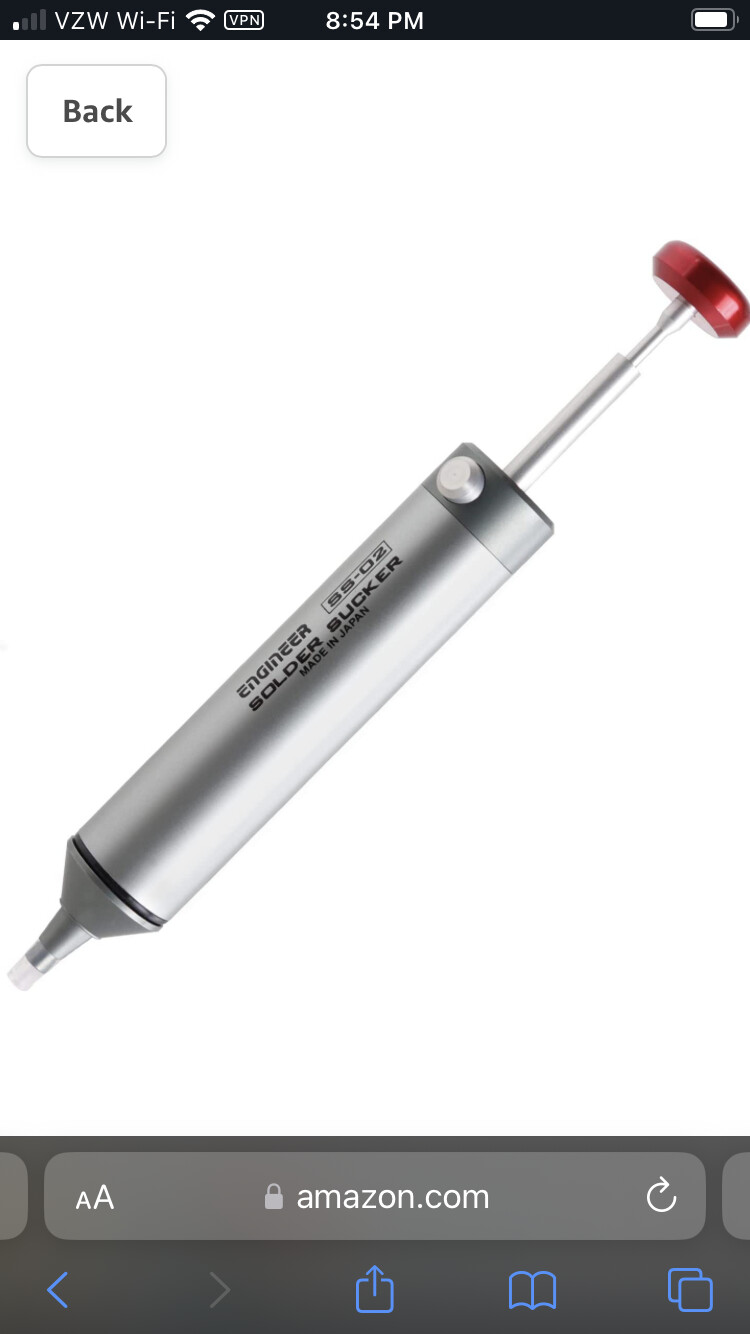
1 Like