If you read my question more carefully, the question is asking about ribbon… If you have the answer would appreciate if you can help. Again, for 3rd time (emphasis on bold):
5. AMT diaphragm is folded but ribbon is not , is that correct? Therefore is it correct to write that AMT diaphragm can be described as squeezing air but ribbon cannot ?
Very interesting
Indeed. This thread is not seeking answers on which is better or best. Moreso just understanding differences. Once again, see my earlier example of marketing that causes confusion.
Yes, an AMT dipagragm is folded and these pleates move laterally, squeezed together like a bellows.
When you say ribbon, there are actually two things that you might be referring to:
A pure foil ribbon
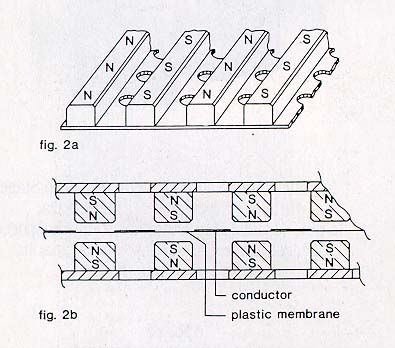
A planar magnetic (which Igor/BG calls planar ribbon or infinity calls EMIT/EMIM). These are like a flex circuit have a polymer backing and and conductive traces.
These move axially, like a traditional dome tweeter but diaphragm is directly driven axially by the magnet system.
Yes, while there are different embodiments, some AMT magnet systems use neo bar magnets to the sides of the diaphragm (not front and back), like the parts express ones (and the same vendor makes the goldenear ones as well), which may have similar construction. Without showing simulations, basically center conductors aren’t getting quite as even a flux distribution in these types of design.
The HEDD ones that Rudolph shows have a bit different motor design with an outer steel tube and pot, so it depends on the implementation somewhat.
For a planar (of the symmetric/double sided type), there are magnets in front and behind the diaphragm and so the field and structure very symmetric. Here is a cross section showing the magnets and traces. http://www.integracoustics.com/MUG/MUG/articles/planar/pp.jpg
As I think that Rudolph was alluding to, the implementation matters as much as the core technology. However, I was just trying to give you some background on the various “thin film” driver types, as I do think that there is a bit of a shared “sound” among them, differences, not withstanding.