That is not exactly a breadboard. That is a finished product as far as I can tell. Honestly I know nothing about electronics though. I am very impressed that he does not even keep it secret.
Wonderful! This must be quite satisfying, as well as a bit scary.
Not as scary as the first TSS set or the big red board above. The big red board’s power supplies were trimmed by the control processor. Any bug and it could fry a big section of the board. That was a pretty bad idea 
With the first TSS boards I didn’t really know that the control loop to align the clocks on the digital and analog boards would work. Now I know it will. Still, I redid the control paths from the digital board to the analog board to lower potential interference/noise. It would be good if they work correctly.
Wow, these look great! Especially the analog board!
Way cool. Thanks for sharing, Ted!
Digital board…
Switch mode power or just not yet fitted with transformer?
I see 2x HDMI IS2, 2x AES, 1x toslink and a space for a coaxial SPDIF input, but is there also to be a USB? (I quite like the idea of no USB input on a product like this).
Analog board… no AC input receptacle on this one so is it safe to assume the AC power is handled on a separate board?
I’ve never been convinced by USB as an input, though I’ve not heard these high end DACs so what do I know?
Just such a dirty bus usually…
USB (and networking) will be handled by the display processor. (Keep the noise away from the inside of the box.)
Power transformers are off board:

There will be one for the digital box and two for the analog box. Each has four windings. One transformer on the analog box powers each of the four analog supplies. The other transformer in the analog box and the one in the digital box have all four windings in parallel for more current. The digital box does have two switching supplies: the switching regulator chip has onboard caps to lower the loop area so that there’s very little radiation. As an experiment we tried one of these in a Jr, and it sounded good. In principle noise in the digital box shouldn’t matter since there’s an optical cable with reclocking on the other end. Still I’m keeping close tabs on noise in the digital box.
On the left of the analog board there was an AC inlet, fuse, cap, switch, etc. just like the digital board. Someone at the board house thought we wanted it to be cut off of the rest of the analog board 
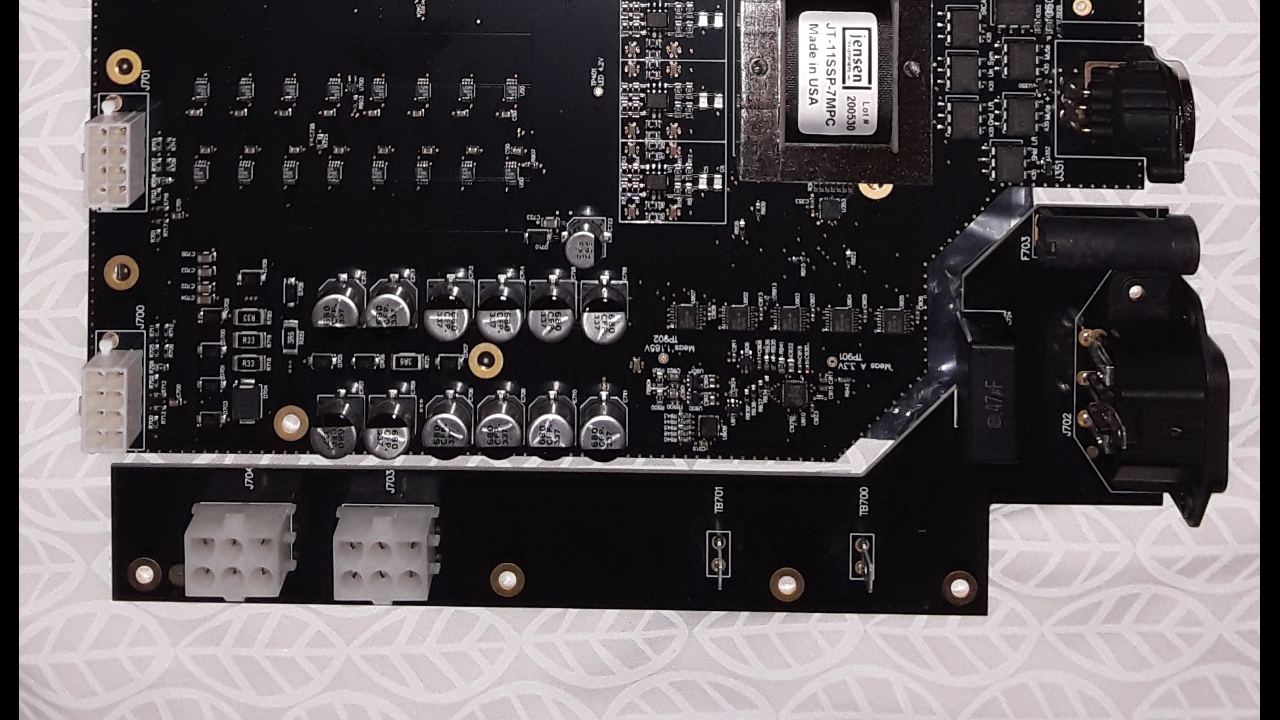
Haha! That’s hilarious!
PSU stuff all makes sense to me now, thanks.
When you say USB and networking to be handled by the display processor… is that still all part of your digital box? The “display” connector on the main digital board would be a kind of I2S input as well as IO for control and status signals? The display system sounds like it’ll be a Pi-class or smartphone-equivalent device in its own right.
The display processor is serious. It (and the display) will be mounted on the front of the digital box. Yes there will be a couple of high speed serial connections from the display to the digital board. The display processor will be able to access everything on the digital board (and thru that the analog card.) Tho I have a control processor on the digital card, it’s only used for my development until the rest of the box is ready. We won’t stuff the control processor related components on the production boards.
Great stuff! So at least in the digital world no one can say less parts mean better sound 
The only hint I have experienced to assume it does, is that (let’s say metallurgical) measures to improve signal transport have their best effect with low level signal components and DAC‘s. But I still guess this is mainly related to the analog section.
Love the black, like Auralic. Looks professional. This is totally silly but the traditional green boards now look cheap/outdated to me. Same for the surface-mount vs through-hole components, as well as thoughtful use of space, lines, grouping vs everything seemingly crammed together randomly on a too small space. Anyway, this is how far my understanding of boards goes…
The black does look serious, intense.
Now try to tell your wife how you think about printed circuit boards without feeling ridiculous;-)
It was nice that the DS was a pretty simple design, the schematics were pretty simple and clean.
On the digital TSS board the isolation of each input (especially the I2S inputs) adds a bunch of components. As does the top level power supply that gets a high power factor (it sips current over a lot of the AC input waveform rather than gulping it at the peak like many linear supplies.)
Like the digital board, the top level supplies on the analog board take a lot of space and there are many local voltage regulators that take up more space (you can see a bunch of test points for various supplies a little to the right of the center of the board.)
Still the “analog” path is just about the same as the DS, except there are twice as many digital switches and better components are used thruout.
Speaking of wife: this is the first board (ever?) that didn’t show up right at our wedding anniversary. The timing was quite a joke here. At least my wife has a sense of humor about it.
Here’s a plot of the input voltage, input current and input power at power up (50 runs with different input voltages and component tolerances):

Hi @tedsmith,
Will the TSS replace the DSD or will you continue to sell the DSD along side it? I’m assuming the TSS be quite a bit more expensive than the DSD?
Also do you have an estimate launch date as yet (all things COVID permitting)?
The TSS will be a new product in the PS Audio line up. The DS will still be available as the TSS probably going to be three or so times as expensive as the DS. Launch is still unknown, Paul’s last guess is a few posts up:

If not a pure linear power supply, is it a switched mode power supply?
It is a pure linear power supply. It’s just more linear than most. It draws current close to linearly with the voltage rather than filling storage caps just at the peak of the AC waveform. A simple version is to use small caps for filtering and to fill them thru resistors : they don’t do a lot of filtering but they fill over a lot longer time so the current is better aligned with the voltage. The varying voltage is then regulated with standard linear regulators. Since the current draw in each boxes is pretty constant you can size everything to keep the input caps filling over most of the input waveform.