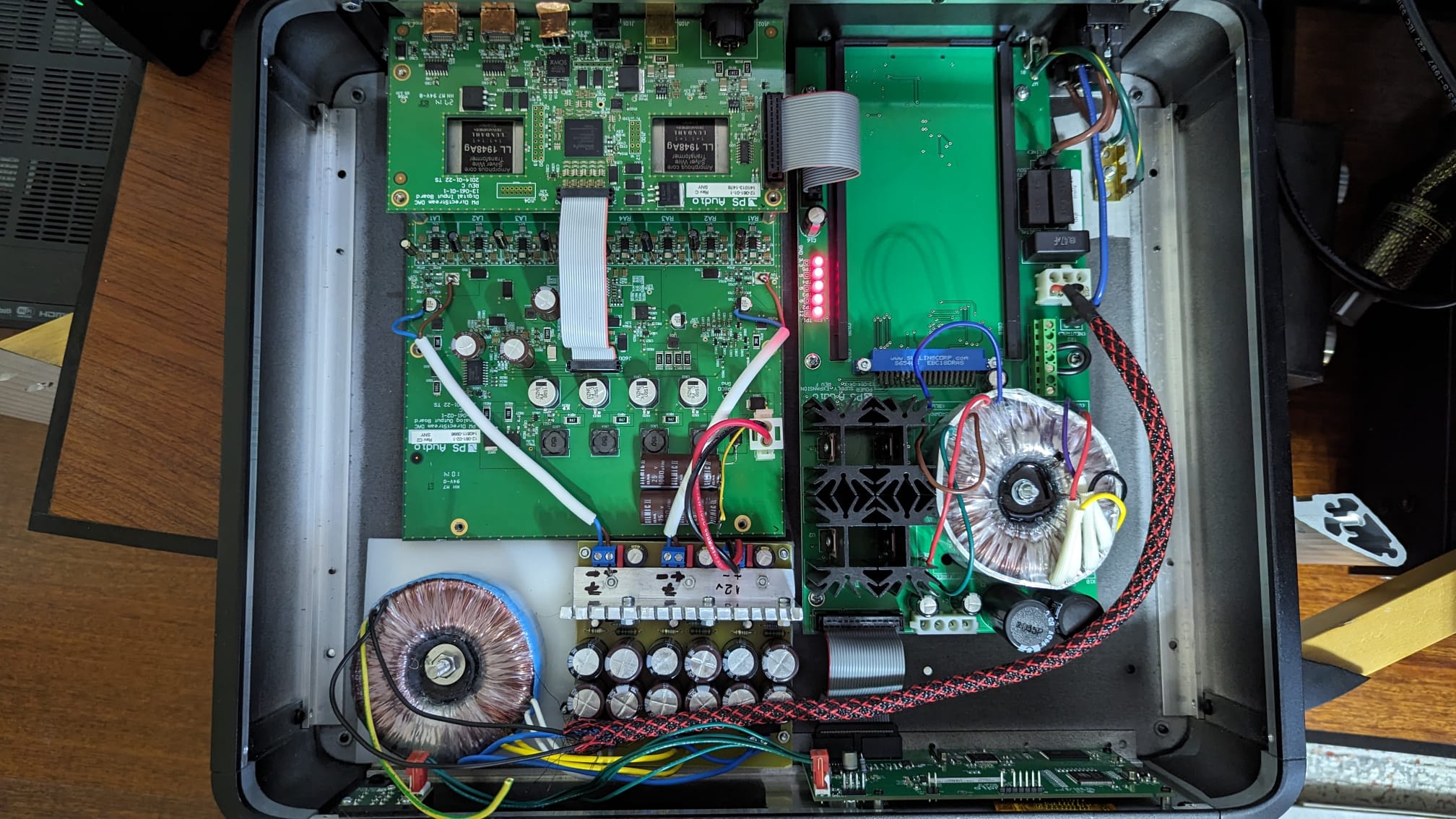
This effect exists for all devices with linear power supply (with a conventional transformer). It’s the more noticeable the more transparent/revealing system is.
If you have a PS Audio Power Regenerator with CleanWave function, you don’t need to reboot. Just use CleanWave every now and then.
CleanWave injects a series of higher frequencies that ride on the main sine wave to help
“degauss” connected magnetics.
Besides some degauss discs, I also have the Gryphon demagnetizer, which I could try on the next occasion, but I’m quite sure this is a different, more sound critical topic. Ted also confirmed here, that the FPGA develops some sort of “confusion” that has to be cleared with a reboot occasionally.
CleanWave works for me.
I also used demagnetizing CDs back in a day.
Yeah, try this demagnetizer. And let us know if that works.
I don’t recall where Ted said that. I won’t deny that.
But, if that’s true, then FPGA-based DACs, as a class, would have this as a main disadvantage. And everyone would have known that…
Well… unless, as you said, this could be (one of numerous) DirectStream-specific flaw…
Well, in the first thread, I didn’t find anything informative on supposedly FPGA-related issue. They just said, in general, that it’s a good rule of thumb to reboot every now and then.
On the second thread, as far as I understand, they’re discussing flaws of the old firmware and power glitches, again, in general.
But, what was more interesting was that the first topic shows that the i2s problem (with unwanted voltage) existed even in 2020. It’s not new and specific to AirLens. It’s specific to DirectStream mk1, my understanding.
So the AirLens owners actually have to reboot their mk1s, and don’t forget to unplug the i2s cable!
You, @jazznut, obviously, witnessing other kind of degradation/enhansment situations with rebooting than me when I’m using CleanWave. I’m not using i2s.
I didn’t hear 3D collapse. What I noticed in my system is not as dramatic.
I will just keep degaussing some “grunge” once in a while. That’s all I need.
Hmmm, this might also be the explanation to why i2s converters like Matrix don’t meet expectations… I haven’t tried myself, but I noticed a tendency of PSA-people were buying and then shortly after were selling them. I wonder if that’s the case.
I know I am in the wrong thread, but MK2 Mod is dead.
I just want to mention when I first did the APS mod for MK2, the bottom of MK2 was hot and it made me worry.
After three months, the bottom is just warm. So, it does take a long time to break in the transformer. The sound quality can only be described as amazing! I believe with this mod on MK2 it can compete with any DAC at $15k level, and probably higher.
So we had the demo in Dallas Monday. It was a smash, the DAC is stunning. There’s no distortion and it’s transparent as heck. The sound out of it is big, bigger literally and figuratively. It’s somewhat like being transported and listening in the venue or studio (thus the name, Studio version), rather than at the end of the chain. The ambient space the music exists in is big. I connected so strong to Wynton Marsalis/ Dianne Reeves vocals on an excellent jazz song (Feeling of Jazz) that I literally had tears in my eyes. On a jazz song lol…
This strong connection used to happen ~ routinely in the good ol’ analog days; much less so unfortunately in the brave digital era.
BTW- IME the DS sounds much better still, esp in the vocals, when it is fed DSD128 rather than PCM. My friend’s streamer offers that conversion on the fly on (most of) the input files; it works well. I have also done some offline conversion of PCM to DSD and the results sound better; more clear, more real in the vocals. Just FYI.
We could stop here on it and call it done. However, (lol ack) I’m going to try and improve the all discrete, ultra high perf gain block circuits (“error correcting”) further. We may not be able to, but will try.
I have a design here now that has nearly 130dB OL gain at 1KHz (160dB at 10Hz lol) (can we say perfect bass? I knew we could); this is unusual and extraordinary.
Configured in a closed loop gain of 26dB circuit, the simulated distortion at 1KHz at 3V pk Vout (2.1V rms) (+6dB) into 1K load is ~ non existent; by ~ non existent, I mean the first harmonic D2 is -145dB lower than the fundamental, into a heavy load for a line level app). That’s over 7 orders of magnitude (10^7) lower See below.
The simulated closed loop noise is only about 70nV/rtHz; and most of that is from the feedback and input resistors (ie, it’s very, very low).
Among other things that set it apart from the norm, it uses an innovative class A output stage that requires no bias spreader (good).
As I’m found of saying these days, if we want to break out of the same ol’ same ol’, More of the Same ™ we have to do things different (and better). And we are for sure breaking free lately,TG.
So I’ll build it asap and we’ll see if it can be achieved in reality (stability is always a question). But assuming it is stable it will likely be extremely good sounding.
Think I’m also about to buy another unit for Studio conversion now. My friend in Dallas has the Studio unit #1 now in his system. I have 2 here, both the prev version that can be converted to Studio; I’m going to save 1 unit for now as a prev version reference. The prev version is also quite good, but it pales in comparison to yanking out the industrial diff amp cork…
I’m intending to do the 2nd Studio unit with the new TK analog circuits. Ultimately may the best sounding circuits win We shall see.
TK
Studio DAC in the system; below that is also the new super preamp. And he added a new LHY SW-10 to the network section.
Yes, the results are inspiring for sure Looks like the new, improved(?) analog circuits should also work, at least according to the simulator results yesterday. We’ll start building it asap. I’m hopeful.
But even if not we can roll with the existing setup just fine. A good place to be.
I also bought another DS Mk1 to mod. That makes (4) → (3) for me now (friend has Studio #1). I hope the seller comes through at least, starting to wonder some
BTW to try and explain the above analog circuits a bit, having and wanting all that open loop gain provides the “muscle” to “error correct” when we close the loop. Doing so (can) drive distortion and noise into the dirt.
Know that I’m an open loop but highly linearized circuit guy at heart, because it generally sounds unbeatable IME. The super preamp is thus so; we can do it there because we don’t need more than unity gain.
But this DSD DAC app needs gain, so we need gain blocks. But to get the best results we need those blocks must be absolutely t*ts up, the best we can do. That’s what we’re doing.
We could avoid needing gain if our re-clocker drove out DSD bits of say, 3V amplitude But it doesn’t, and likely wont anytime soon.
But that’s an idea, we might buffer and gain the re-clocker bits using say, some old HCMOS or something. Could it run ok at 5.4MHz? I think maybe so. Then we could buffer with the OL unity gain super buffers I’m sure it would be fabulous. An idea we can consider for another time
But the “error correcting” gain block path got renewed interest for me this summer when we built the TK Modulus error correcting amp boards (thanks to Tom C of Neurochrome for modding and making the TK edition board design). The sonic results of “error correcting” approach were very, very encouraging… So here we are now doing similar with the DAC.
The rub is, we cant get the actual sonic results we need via industrial integrated devices; so we try and build it discrete. In other words, we’re building our own discrete Super pro “error correcting” op amps basically. Easy to say, but…
Can anybody explain the vocm mod and list the best mods for the DSD1? I see it mentioned a lot but not what it is. 5500 posts is too many for me to go through.
Oh, the PSU toroid; think I recall about 20V raw DC out on the PSU to the 12v linear at least. Below should be the stock toroid pinout. I had to replace one due to a boo boo; I had to select a slightly lower Vout toroid, which is ok in my book as it also lowers the heat dropout burden on the main 12v reg. Think I used a Triad VPT12-4170. I added my own band shield.
The Vocm mod, basically we are placing an AC bypass on the Vocm voltage divider node for the diff amps. We want that node to have as low an audio band AC impedance as we can. It basically sets the output reference voltage of the diff amps. Obviously we want that reference to not move around at all, dynamically. TK
here are some photos and description of my DAC. The last few months a friend who does all the soldering and myself made the mods each at the time. Not everything is finished.
Thank you turbotk for your help! I am not there yet and still have some quiestiosn regarding balanced power supply to the AD8139 : )
I changed both for analog and digital (although analog is not required anymore after the last changes)
Shield and TDK EMI-Tape
The tape is covering the ribbon cables and the aluminium shield is around the analog and digital board. Copper for the shield would be nice but is very expensive
Cut trace from display to above mentioned low noise regulator and connected display to unused other 5V LM317
Replaced some capacitors
I did hear those changes
Analog board:
First went for the Edcores and later to the Nickel ones from Jeffrey
I could hear both changes and had to change power cables and interconnects each time. They improve the sound clearly but also change bass and treble somewhat
The ultracapcitors mod was very hard - especially cutting the tiny trace of the stock 3.3V.
What is still open:
Vmod modification and change of parts in that section and output buffers (each with a dedicated PSU and trafo for left and right). Also the change to ther AD8139
Holy… wow. That’s impressive for its commitment and audaciousness, even just as seen in photos.
I’ve had the chance to listen to some highly modded DACs in my time, not all of them to my liking. What sort of sound are you going for? In what ways does the sound you have now need to improve, in your view?
You really should have the Vocm mod by now… It’s pretty big.
Rather than switch to the 8139, you might consider these instead: LMP8350 Ultra-Low Distortion Fully-Differential Precision ADC Driver
I liked them, and they are in the DAC DW was using until the new Studio version came along. his buddy also loved it. And the 2nd version of Studio, with my own new, discrete “error correcting” analog output circuits should be coming along soon. Should start constructing finally this week in fact.
As for bi-polar supply to the Diff amps you don’t need that unless you are planning to also run with no trafos or caps. However you have to really be committed to the cause for that, as there are some large problems that come along with it (eg, 3.5v CM voltage on the inputs, AND a power on crowbar condition that occurs).
I’d likely instead recommend for most to just stay with the single pole supply and trying caps instead of trafos on the output.

 See below.
 We shall see.


 But it doesn’t, and likely wont anytime soon.