I believe the Bridge II & its I2S implementation are pretty special in allowing MQA unfolding to 192k.
I take it that going further again requires help from the DAC, which won’t be forthcoming, so it will simply unfold to 96k.
Does raise an interesting issue of whether the AirLens would help to get a full unfold with a different DAC. Perhaps that’s the point? It could be the best streamer you can get, but it needs the DAC to be ok with DSD or MQA to unlock them?
But I’m not sure it’s an extra cost issue that could be priced in if the DSII simply isn’t going to do the final MQA unfold.
Hi, with the confirmation that the AirLens will unfold MQA to 88/96kHz I think pretty much everything is known other than when it will be released. A quick overview…
What it will do:
provide a standalone streamer in the Perfectwave range
Size: Half size chassis, approx. 10.25″ W x 8″ D x 2.25″ H
Sound quality: will be the same as the PST because we’re using the same galvanically isolated output circuit. So, be prepared to hear streaming as never before.
Power: It will have AC in so it will not benefit from a DC converter
The MQA licensing cost is probably pretty minimal, given that the $500 node streamer/dac is full MQA. There are dozens of other low cost examples. I like MQA., but have no desire to argue about it. PSA went a different route.
Topping sells two DACs, the D90SE and the D90LE. The only difference between the two is that the LE supports MQA and the SE does not. The price difference? $100
That’s probably the closest we’re going to find to a “real” cost difference. If you want MQA you really need an MQA capable DAC. Trying to do “full unfold” anywhere else is a hack. There are cheap MQA DACs that measure really well.
But I’ll give you another theoretical reason not to do full unfold before the DAC. The DS has a lot of, we’ll call it magic, in its upsampling / conversion to DSD which includes custom filters and modulators. MQA has its own filters because Bob Stuart has very specific opinions on pre-ringing and time alignment for PCM. All of the things Bob is trying to do with MQA goes away when you then add another conversion to it. So unfolding MQA and then feeding it to a DAC, where that DAC is going to do its own “magic”, really makes no sense. It’s not entirely about the upsampling to 384 but the filters that handle things like pre-ringing and aliasing along with that upsampling. And, I’m not even trying to throw an opinion around on if I agree with Bob.
What I’m really trying to say…
Buying a DAC from a company like PS, who is firmly in the DSD is best camp, and then wanting anything to do with MQA is a direct conflict of philosophy. MQA is a method to bend PCM to what Bob Stuart believes is “right”. The DS DAC is PS Audio’s statement of what is “right” for digital audio and it’s a completely different, and incompatible, method to MQA. Pick a side!
These are retail, right. So if the question is what is the actual cost to license, it is likely multiples below $100 (although I have no actual idea how much), given that almost always in consumer products like this, the retail price hike for any given additional add to bill of materials is a severalfold multiple.
Yes, retail. The MQA version uses a different XMOS USB chip (which is where I’ve always suspected all the “unfolding” is happening in these inexpensive DACs). The retail difference between the two chips, single, is ~$6. XMOS supplies MQA firmware off the shelf for the chips that support MQA. It’s cheap / easy. I do not know, for designs that do not use XMOS, of the additional costs of development to implement the unfold or where exactly this operation could take place. I understand this stuff just well enough to form opinions and share those opinions on the interwebnettubes.
I don’t want to argue the merits of MQA, just a comment about the implementation in the Bridge II and DS mk1. The MQA filter does not need to be the last filter in the chain, it just needs to know what filters are after it to do the proper end to end decode and render. The Bridge II MQA is not undone by the DS mk1 filters, it works in conjunction with them.
Edit: This is consistent with MQA and digital filter theory, but I don’t know that the Bridge II software was actually written that way.
Right, I’m still a student to this stuff as well. I hate to say it, but I don’t care for the sound of MQA and find it to be a bit of a gimmick. Thus my motivation around learning all of it only goes so far.
Barry did follow the last two points with, The last two points should be equivalent.
How about we take up a collection for confirmed DS MKII DAC and AirLens buyers to replace any files that they already bought in MQA with DSD128 versions? This way, there will be no cobwebs of higher resolution data folded into the quantum m-space of their files. Everything will be clean like in Hilbert space. Not to say that everything must be right angles for me, of course.
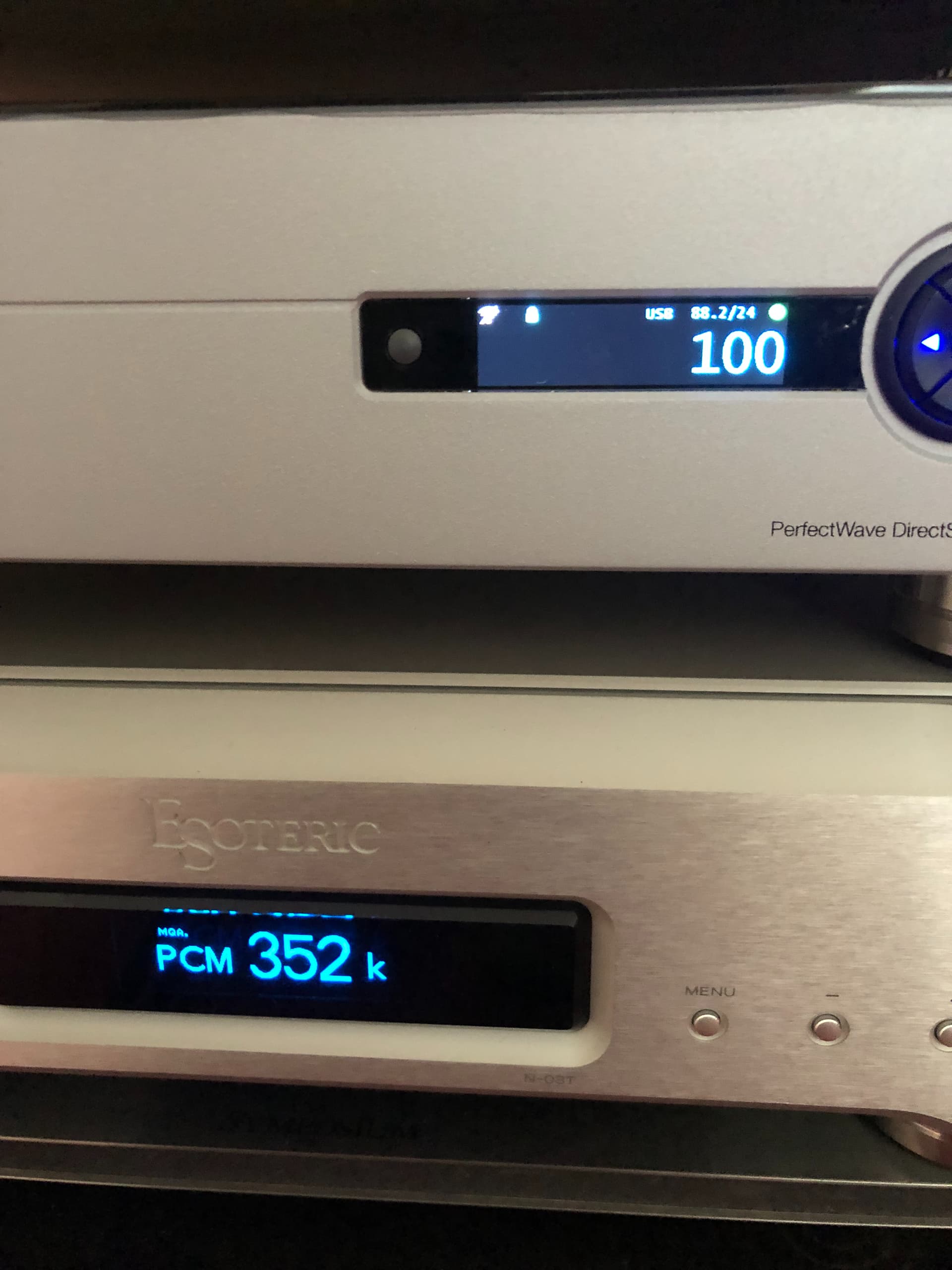
My streamer unfolds the MQA to 24bit 88.2 khz. That means I need another unit to unfold it again for full MQA. Why can’t they put the full unfolding in just the streamer instead of making it so complicated. Why must you need so many units for MQA?
My streamer for the price should have full unfolding, but it don’t. And when I play this partially unfolded file, it really sounds quite crude, even the regular files of the same recording sounds way better, not to mention DSD256 which completely blows away this MQA. I haven’t heard a fully unfolded version, but I don’t believe it will be any better. MQA to me is such a gimmick.
No, if you want sound quality, get a streamer like the AirLens and the DS MKII and play some DSD256 files, Boy, will you be in for a treat!! I’m playing a DSD256 of Bill Evans “Waltz For Debby” and I am completely Blown away by the sound right now, never heard better in a digital format. DSD256 is the thing!
I’m using a Samsung SSD 8T hard drive plugging into a Esoteric N-03T streamer with a Valhalla2 USB cable. I compared a Synology NAS drive to the Samsung and the Samsung is better, can you believe the kind of hard drive and cable can make a difference. The streamer is connected to the DS MKII with a ChordMusic USB cable. I don’t use Tidal or Qobus because I want better sound quality. I only play files.