Belden ICONOCLAST Interconnects and Speaker Cabling

Well, the Big Mac stack is set-up. No cables because your Xmas orders step ahead of me, so I get booted to the bottom of the list. But there it is. It isn’t as imposing sitting in front of it as I thought it might be. They are THERE all right but not so HUGE as I’d imagined. One step at a time, but all the ugly stuff is finished; buying THEM, finishing the room for THEM, getting cables for THEM and dedicated wall sockets for THEM. It is all about THEM.

Now to cable it all up and try my hand at “voicing” THEM in. REL will show up and lay waste to my best try I’m sure.

Have a great Xmas everyone, mine is sitting there!

Best, Galen

14 Likes

I like your “non imposing” six-pack picture; I bet my wife will get a good laugh on that.

Merry Christmas to you and the rest of Belden family!

3 Likes

The secret of how it sounds is still locked away inside…like the prize inside a Cracker Jacks box.

I hope this is inside!

The effect this will have on your reference system as well as what you thought a hifi system can accomplish is transformative. Combining the rest of my system with six REL No. 25s has brought an improvement that can’t be expressed in percentages. Before their arrival, I was listening to well recorded music on a premium hifi system, now I’m experiencing music that, if the recording is of the right caliber, it feels real. This level of improvement is nearly impossible to quantify. - The REL no.25 Six-Pack

Best, Galen

5 Likes

I imagine you’ll feel them as much as hear them.

Merry Christmas!

I will tune each subs X-over today. The final sub SPL level you have to have them ALL on to set, and I don’t have the cable for that yet. I can do each sub by itself for the X-over frequency only. Here is what I will do today;

- there is a song on the sneakers soundtrack that has a steady tympani drum beat for a good bit. I use that.

- turn OFF all the subs.

- turn up the pre-amp level so it is pretty strong on the mains, at least as far as they can play that.

- turn on ONE sub only.

- adjust the subs level to again be pretty strong. L20-L25 or so. The idea is to just hear the CLARITY of the bass, not the volume.

- now I adjust the X-over UP until that tympani drum is blurry or less clear and precise. This is easy to hear.

- back it down until it is nice and clear. This is your X-over point in the stack. This frequency will vary between each sub in the stack. Do this a couple or three time. Try and not look at the frequency, just LISTEN and average the results.

- DONE.

Do that for each of the six subs one at a time to set the X-over where it is CLEAR. The hard part is the levels between them all, who and what sub does how much talking, the levels. The cross-over points you don’t change after the initial tune. Let the subs do the talking on x-over point clarity and ignore the different X-over points to get the same clear sound. They will likely be different.

The idea is to get a better soundstage size and attack speed / clarity. Each sub is working less hard and has less distortion. Stuff is effortless but the SPL should be the same or the bass thumb on the scale is too much. Sure, they can take the house down if you wanted that!

Best, Galen

3 Likes

All of us at Blue Jeans and Iconoclast Cable wish everyone a very safe Merry Christmas and the best for 2026!!

17 Likes

Roger M

2 Likes

Thank you Roger!! Hope you are well!!

What are your go to tracks for listening to bass clarity…not in the sneakers cd? I find songs with acoustic bass prominent (e.g Brian Bromberg ) help me make sure I don’t have tood much of my Rel 31s in the mix.

1 Like

Someone is at home enjoying Xmas! I ended up with three game controllers, I bought one when mine croaked, and my wife got me two as a joke, I play too much on some days, and my son also bought me one. I’m an Xbox store now. Onward to getting wipped out on STALKER II. This is a KB+M game because I can’t aim with the controller.

-–

Yes, on the BASS stuff, I use the sneakers and stuff like Philip Phillips since he uses a lot of bass. As you listen, and a good source pops up, quick sweep the x-over and confirm your settings a few time.

But, you can only adjust the X-over point such that it is clear. Just start high on the X-over and go down, then the opposite, low to high. Listen for the clarity only, no matter what the source it will be clearist at the right cross-over. Some will be MORE clear, but that “best case” point will be the same. My ear hears high to low transition better but you may be better low to high. Try to not look at the handy meter until you read it off for your records! I’ve even covered mine up. I stick an arrow on a piece of masking tape and point it to the receiver on the sub and then shut my eyes and open my ears. This X-over method works with one sub at a time on the six pack.

For the SPL level it’s really hard to do because the mastering is all over the place. Early 80’s to 2000’s has some really light bass and kind of awful overall clarity (all blurry and confused). The series II speaker cables and interconnects help the clarity and sound stage definition tremendously, too.

Newer 24 bit stuff in 2000’s and up I’ve noticed on Qobuz is far better on average. The old stuff digitized is just that, the old stuff on digital, same, same on the sound but more convenient. But, I have also found that Qobuz seems to have used better master tapes of some of my old stuff and it is indeed better, so not all bad, it’s better sometimes. I’ve never heard worse than my old sources; records/CD’s EXCEPT for my records, some are simply outstanding like the old Cat Stevens albums as an example. My very best sources are still records.

Still, we can tune our stereo to play one song REALLY well! I think that’s the joke about equipment versus the music. We get too caught up in the technicality of the stuff and not the music. I use random play to sort of average out my bass SPL.

Best, Galen

1 Like

Galen, I have been following your progress on adding a REL six pack to your system. I have a question as to why you have selected the six pack. First, I know that the system provides a powerful fortress capable of outputting massive clean bass. However, I wonder if you have done any acoustic room measurements to see if you have any problem nodes or other acoustic anomalies. Being the obvious technically astute person that you are, I admire your work and have a full loom of Iconoclast Series 2 UPOC interconnects and speaker cables and BAV power cords. My point is as powerful and expensive as the six pack is, it cannot correct for room peaks and nulls that are present in almost every normal listening environment. Using 4 subs spread in strategic locations would actually provide a smoother, tighter and faster bass output. They can still be connected in stereo pairs and cost less including fewer cables. Just my 2 cents. Either way, I’m sure this is exciting and I would love to hear it. I’d be interested in hearing your thoughts.

2 Likes

Good thoughts on the six pack, but…

All rooms do have nodes. Using several subs placed around the room “averages” the nodes, true, and it does spread the possible listening spots, true. This is all good for a one “dimenisonal” height bass set-up with a more lenient seated position choices. Hint, I sit in ONE spot, thus I now have other options to better fine tune the holograpic illusion thing we call a sound stage.

The six pach adds a VERTICAL DIMENSION that low floor placed subs cannot. And they have two channel prametric EQ, and my T+A P3100HV also has an eight band separate per channel parametric EQ function, too. Tuning my listening spot, not two, five ten or twenty spots but ONE, by taking an ordinary office chair with wheels and move the seat slowly away from the speakers and measure the bass nulls and peaks. I pick the spot nearest the speaker for the elimination of the room (quasi near field) about 10 feet out in my case, and where the bass is at a natural spot between a peak and a null.

Most rooms have ONE real peak and a secondary one off that. You DO NOT need DSP for a sub running at 26 Hz and below! Your mains might, but not the sub. Sure, the curves show stuff up to 300 Hz but that’s bunk, you never run a sub that high. My room has ONE significant peak at 25 Hz in a 40 foot long room, and I use the subs level to adjust the SPL to blend that peak. The next peak is around 50 Hz and is attenuated out by the cross-over slope in the sub. The mains speaker really influence that 50 Hz peak, and it isn’t bad. The preamplifier’s parametric can be used to tune that one out as needed and at that ONE frequency. Trying to wrestle the room flat is a fool’s game as the DSP tends to be overworked and sounds bad in every attempt I’ve experienced over a more natural parametric EQ. Enjoy your room, don’t fight it. Most audiophiles overdamp the living “life” out of the room and the sound is the same, dull and lifeless. It looks cool, but sounds bad. Our ears ENJOY natural and expected room ambiance.

OK, the above describes why I don’t need or have used DSP with subs. The six pack does far, far more than just lower harmonic distortion and dopler distortion by cutting the bass cone excursions, which it surely does. What it does and that I’m paying for (two stereo subs have me covered on bass in general) is the VERTICAL HEIGHT DIMENSION of the sound stage. Not more bass, but where it is perceived. Have you ever heard a six pack at the show? Amazing sound stage height. This is what I want to hear here at home, too. We shall see. I tune for ONE spot to optimize the illusion of a sound stage most precisely and you can’t do that spreading stuff all around. Physics allows ONE “best” spot. I’ll take it!

Is it worth it? Money wise noting is in this hobby, really. So a big no on the money argument. This is a luxury purchase for sure. Is the SOUND worth it and everyone would acquire it if they could? Absolutely. Our cable products are like that, and they do cross an expense bar all can’t afford, but if they COULD get our cables to be at their financial means they sure would by better products. We have held prices to bring these amazing cables closer to more and more people’s affordability range. We are VALUE for the quality you get.

We do this value trade-off every day. As trickle down improves stuff at our financial limits and we can get better things. Do we spend LESS money to hold the performance at the same level and buy cheaper? Some do, but most of us leverage UP performance to a higher level as the entry price for that performance drops. Most will buy a 911 over a GTI at the same price! Fewer would spend less and get the GTI if we wanted the best car we can afford. We all tend to spend our budget!

Can you do this six pack effect cheaper? Sure, but subs that are a better value also exchange that value for performance. Not a new concept. I wanted the best, and I took that route. Tonality of a proper air suspension sub required a LARGE box (no vents or passive radiators). But, I have plenty of room UP. One sub eats up the floor space already.

No, this isn’t a financially logical route, and one few will take. To better hear into the effects of cables, I need to hear as much as I can. It doesn’t hurt to place the sound stage more naturally in front of you. This isn’t about the POWER of the bass, but location of the bass, and in ONE spot. My bass “node” is already optimized where I sit with the proper placement of the TWO, and the VERTICAL soundstage required four more. This isn’t multi seated home theater…here your explaination is valid.

Best, Galen

PS- tighter bass isn’t afforded by placement if the sub can’t get you there. Yes, it can get the best out of the sub, but most subs leave a lot on the table in tonality or power. Passive radiators decrease size and manage TONALITY with lower efficiency and ports also allow a smaller box and have bass POWER, but neither are as accurate in the bass as true full air suspension designs. Air suspension comes at a PRICE with that bigger box. Thus, we have that value equation to work out. POWER or TONALITY in a smaller more affordable package but not both or…get HUGE air suspension subs that do both. No easy way out. Smaller boxes are also much less power efficient and as the frequency drops, this gets far worse.

5 Likes

Excellent explanation on what a six pack can do. Thanks!

I’m thinking now either do no subs, or just do six pack. This rabbit hole is buried before I get the shovel, I’m safe😆

2 Likes

You will hate me for saying this, but 2 subs would really help up your already fantastic system.

2 Likes

I know they will help, but subs didn’t pass my wife’s beauty contest on components :laughing:In fact they came in last place, and will mess up my cable arrangement forever. I consider that’s a sin.
1 Like

Would only be 2 extra sets of cables similar to this one set…

1 Like

I heard PSA’s new sub can do WiFi, and that will be interesting.

Wait, did you get a 2nd sub? That will sound better (based on all comments from sub owners, more sub is always better :laughing: ).

1 Like

I keep getting reminded that I need a 2nd sub, but still have only 1. I am happy with what the 1 good sub does for my system, and is going to have to hold me over for a while.

1 Like

Congrats on six pack Ii enjoy my four 12 inch stacked woofers in my speakers I did have to resort to DSP room correction to calm the room pressurization of LF due to running monster speakers in a large room vs having a huge room. I found the difference in room correction and whether it preserves the speakers character is interesting the Lyngdorf RoomPerfect does more across the room even in a focus mode whereas Bacch-DSP with Optimal Room correction flattens to a distinct curve for a single listening position. I found myself liking RoomPerfect over Bacc-DSP ORC more until I started using Frank Olive curve over the flat Katz Curve since Olive curve is closer to way my speakers were voiced and I have been accustomed to and easier to connect to music than hyper clarity that Bacch-DSP , Series 2 SPTPC Bi wire

I am interested if six pack sends you to towards reducing bass or moving speakers or listening position. Or resulting in other changed

I jumped over to full Series 2 SPTPC speaker cables wires and jumpers for LF, MF, and HF and sold series 1 after being mesmerized by Series 2 SPTPC clarity I run, 8 Ohm XR290 see my avatar triwire with MC 1.25KW auto formergby

amps. I never tried series 1 SPTPC series 1 on LF before selling the set of cables and jumpers.

My curiosity is back, what does series 2 on LF give me in sound and performance change? Is it warmth series 1 vs. clarity in series 2 LF? I am wondering if I should go back and try a series 1 pair on LF? Then if better go the triwire route separately running series 2 on MF and HF instead of using short series 2 jumpers to HF?

My amp autoformers have two, four and 8 ohm taps so I could mix up what is driving what. Unfortunately zi lack impedance curves and taking speakers someplace to measure each section HF, MF and LF isn’t feasible.

In the end I am not sure splitting LF off series 2 back to series one buys anything if you’re already doing room correction.. Maybe you can postulate?

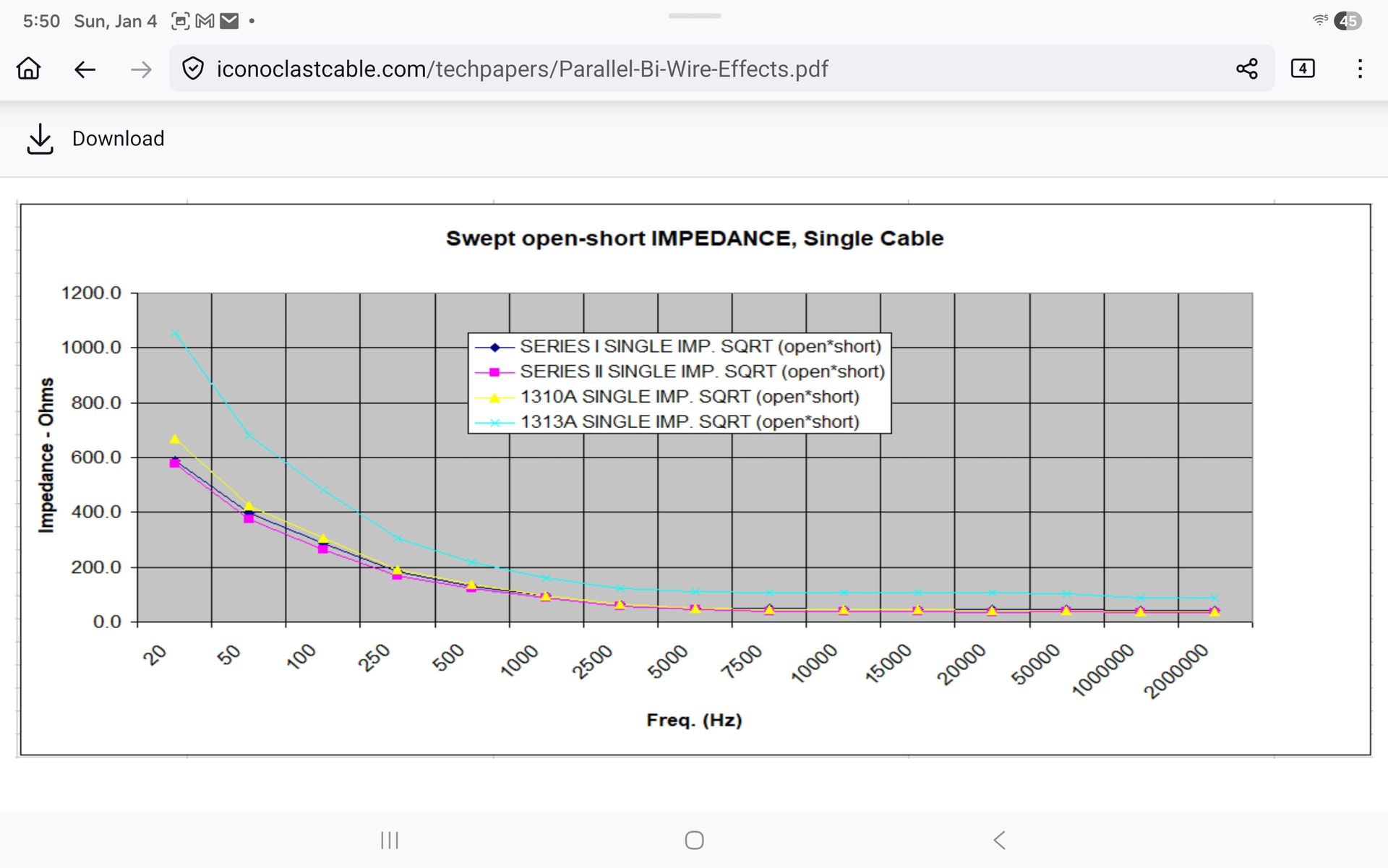
Technically, and you’d expect this answer from us, the low frequencies are fully diffusion coupled through the copper no matter the size. The wire is almost 100% efficient. Bass requires high CMA, circular mil area (wire diameter in mils squared), to lower the voltage drop across the cable with the highest current flow…the bass! Voltage drop = current times wire resistance, so we want wire resistance to be as low as is reasonable. This is why we suggest to use the series I on the bass and the series II on the mid/treble. The series I has higher CMA. I even suggest to use the BAV 1310A star quad wired to lower the cable impedance (nearly as low as series I and II) and meet DCR requirement at a lower price to afford the series II in the mid/treble where the science says it is truly different. Typical zip cord (1313A) has a much higher input impedance at the lower frequencies where we want it to be as low as possible all things considered. 1310A wired star quad is a great and economical bass cable. The open-short measured impedance data simply shows why.

Look at the Vp curve chart below and you’ll see the impact of Vp correction goes away below about 300 Hz. No need to use many, many, many and smaller wires for the bass with more expensive cable. I use bi-wire with 24 AWG series I and 28 AWG series II on the bass and mid/treble respecively for these reasons.

The series I and II are steps in improving the Vp linearity, not improving the bass over making sure CMA area is adequate to not see the cable as a big resistor. The “best” choice, ignoring value, is the CMA area, or series I design. series I choices have the lowest impedance and the highest CMA.

That’s the data talking as to what to do and why. After that it’s pretty much off the science tract.

Best, Galen Gareis

1 Like